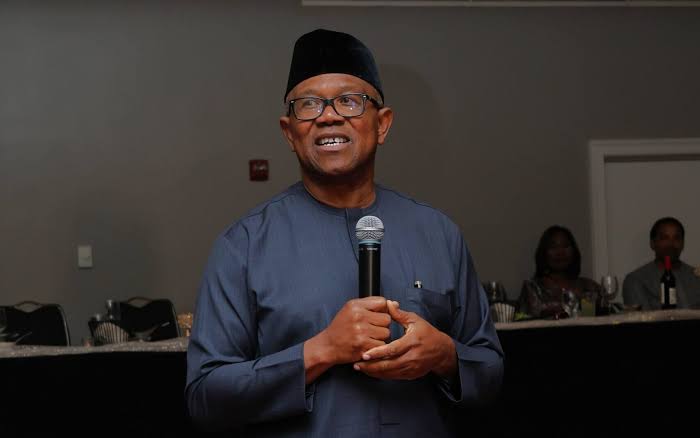
Political economist and chieftain of the Nigeria Democratic Congress (NDC), Professor Pat Utomi, has said the party’s presidential candidate, Peter Obi, intends to strengthen the naira to ₦500 against the United States dollar if elected president in the 2027 general election.
Utomi disclosed the proposed exchange-rate target in a post on X on Thursday, describing it as a central component of the party’s economic agenda and a strategy to reduce inflation, improve purchasing power and ease the cost-of-living crisis affecting Nigerian households.
According to the political economist, the proposal would be supported by investments in infrastructure, electricity, security and domestic production, alongside structural reforms intended to improve economic competitiveness.
Utomi argued that strengthening the naira could reduce the cost of imported goods and production inputs, potentially easing pressure on food prices and other essential commodities.
He said the party was targeting an appreciation of the exchange rate from approximately ₦1,350 to ₦500 per dollar.
“We are convinced that targeting a strategic appreciation of the exchange rate by reasonably strengthening it from ₦1,350/$ to ₦500/$ as part of our manifesto is a winning strategy,” Utomi said.
He further argued that the proposed approach could help reduce poverty and improve the living conditions of Nigerians experiencing multidimensional deprivation.
Utomi Projects Lower Food Prices
Beyond the exchange-rate target, Utomi projected substantial reductions in the prices of several essential commodities under the party’s proposed economic programme.
He estimated that a loaf of sliced bread currently selling for ₦1,750 could fall to ₦800, while a 50-kilogramme bag of imported rice could decline from ₦55,000 to ₦27,500.
He also projected that a medium-sized tuber of yam could drop from ₦2,400 to ₦1,200, while a 50-kilogramme bag of maize could fall from ₦75,000 to ₦37,500.
Other commodities identified in his projections included plantain, chicken, eggs and garri, with Utomi suggesting that their prices could decline significantly if the proposed economic measures were implemented successfully.
However, the projected exchange rate and commodity prices remain political and economic targets rather than guaranteed outcomes. Their achievement would depend on factors including foreign exchange availability, monetary and fiscal policy, domestic production, investor confidence, energy costs and the efficiency of supply chains.
A stronger naira could reduce the local-currency cost of imported goods, but exchange-rate appreciation alone would not automatically guarantee equivalent reductions in consumer prices.
Economic Policy Takes Centre Stage Ahead of 2027
Utomi’s proposal comes as economic management, inflation, food affordability and the purchasing power of households remain major issues in the debate over Nigeria’s political future.
The NDC’s proposed exchange-rate target is likely to attract scrutiny over the practical measures required to achieve such a substantial appreciation of the naira and maintain it without creating new pressures on foreign exchange reserves or domestic production.
For Obi and his supporters, the proposal provides an opportunity to present an alternative economic programme ahead of the 2027 election.
The critical questions will be how quickly the proposed reforms could be implemented, how the government would finance them and what safeguards would be introduced to ensure that improvements in the exchange rate translate into lower prices and better living standards.