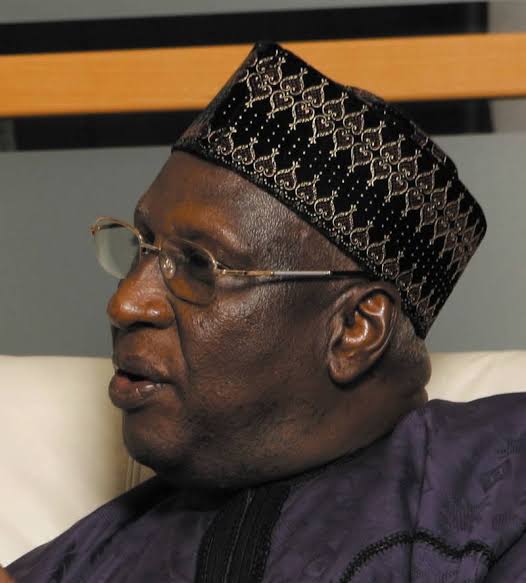
President Bola Ahmed Tinubu has mourned the death of elder statesman, businessman and former governor of the old Gongola State, Bamanga Muhammad Tukur, who died on Saturday at the age of 90.
Tukur was a prominent figure in Nigerian political and business circles whose career spanned public administration, governance, industry, politics and continental business leadership.
In a condolence statement issued by his Special Adviser on Information and Strategy, Bayo Onanuga, Tinubu described Tukur, the Tafidan Adamawa, as a towering figure whose death marked the end of a remarkable chapter in Nigeria’s political and economic history.
A Career Spanning Politics and Business
Tukur’s public career began in administration and business before he entered electoral politics.
He served as governor of the former Gongola State in 1983, although his tenure was cut short by the military coup that ended the Second Republic later that year.
Gongola State was subsequently divided into what are now Adamawa and Taraba states.
Tukur later served as Minister of Industries during the military administration of General Sani Abacha.
His influence extended beyond Nigeria, with the elder statesman occupying prominent roles in African business and investment circles.
He served as Executive President of the African Business Roundtable and was involved in the NEPAD Business Group, contributing to discussions on African economic development.
Former PDP National Chairman
Tukur also became a major figure in Nigeria’s party politics.
In March 2012, he emerged as National Chairman of the Peoples Democratic Party under the administration of former President Goodluck Jonathan.
His tenure coincided with a turbulent period in the PDP, which was dealing with internal disagreements and growing divisions ahead of the 2015 general election.
Tukur eventually resigned as national chairman in January 2014 after months of internal party crisis.
His political career nevertheless remained significant, particularly because of the range of positions he occupied across government, business and political organisations.
Tinubu Pays Tribute
President Tinubu said Tukur’s contributions extended across several areas of national life.
According to the presidency, his career reflected a combination of public administration, politics, business and pan-African engagement.
The president also described him as a man whose experience and counsel contributed to Nigeria’s political development.
Other political leaders have also expressed condolences following the announcement of his death.
The Whistler reported that Tinubu, ADC National Chairman David Mark and Adamawa State Governor Ahmadu Fintiri were among those who mourned the former PDP chairman.
A Veteran of Nigeria’s Political History
Tukur’s death represents the passing of one of the figures whose career cut across several eras of Nigeria’s political history.
He participated in governance during the Second Republic, served under a military government, returned to democratic politics and eventually became national chairman of one of Nigeria’s dominant political parties.
His business career also gave him a prominent role in African economic affairs.
He was born on September 15, 1935, and held the traditional title of Tafidan Adamawa.
At 90, his death closes a political chapter that stretched across more than five decades of Nigeria’s modern history.
For President Tinubu, the death is the loss of an elder statesman whose career, according to the presidency, reflected a significant contribution to Nigeria’s public and economic life.
Tukur is survived by his children and family members, while tributes are expected to continue from political, business and traditional institutions across the country.