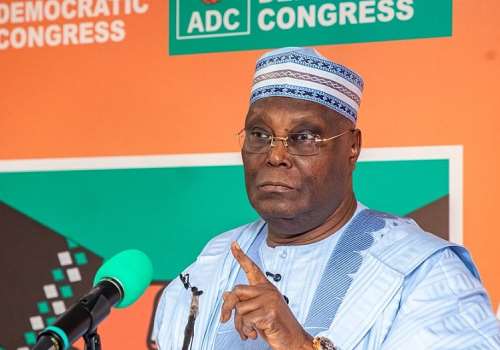
Former Vice President and presidential candidate of the African Democratic Congress (ADC), Atiku Abubakar, has criticised the Federal Government’s 30-day petrol discount programme, describing it as a temporary intervention that does not address the underlying pressure of high fuel prices on Nigerians.
Atiku reacted to the announcement on Thursday through Phrank Shaibu, Director of Strategic Communications of the ADC Presidential Campaign Council.
The Federal Government had announced that petrol sold through NNPCL stations would be discounted for 30 days, with public transport operators given priority. Finance Minister Taiwo Oyedele said the arrangement was not a return to subsidy but an effort to sell petrol at cost during the intervention period.
Atiku, however, argued that Nigerians require a more durable solution to the rising cost of petrol and its wider effect on transportation, food prices, businesses and household incomes.
He questioned why the government was only introducing temporary relief after years of economic pressure following the removal of the petrol subsidy.
The former vice president’s criticism comes as the government attempts to contain renewed fuel-price pressures through a combination of measures, including the 30-day discount and a proposed ceiling on petrol landing costs.
Atiku argued that the latest intervention should be judged against the broader cost-of-living crisis confronting Nigerians rather than viewed in isolation.
His criticism also carries an unmistakable political dimension, coming as Nigeria enters the countdown to the 2027 general elections and opposition parties intensify attacks on the economic record of the Tinubu administration.
The government, on the other hand, has maintained that its reforms are designed to correct longstanding distortions in the economy and establish a more sustainable framework for growth.
The dispute reflects a wider disagreement over the balance between short-term relief and long-term reform: while the administration insists that temporary measures can cushion citizens during periods of market volatility, its opponents argue that Nigerians need structural reductions in the cost of living.
The immediate impact of the 30-day discount will therefore depend not only on the size of the reduction at NNPCL stations but also on whether lower fuel costs translate into cheaper transportation and reduced pressure on household and business expenses.
For Atiku and the ADC, the measure is insufficient unless it forms part of a broader strategy capable of delivering sustained relief beyond the 30-day window.
The government will ultimately face the more difficult test of demonstrating that its intervention can ease current hardship without reopening the fiscal pressures associated with the subsidy system it abolished.