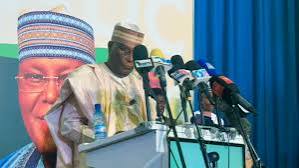
Former Vice-President Atiku Abubakar has mocked President Bola Ahmed Tinubu over the Federal Government’s 30-day petrol discount, accusing the administration of adopting his proposed production subsidy approach while leaving out what he considers its most important elements.
Atiku made the remarks in a statement released on Friday, October 9, as the debate over the government’s temporary fuel-price intervention intensified.
The former vice-president compared Tinubu’s approach to that of a student who copies another student’s examination answers but fails to remove the original student’s name.
“Bola, you are like a dull student who copied his classmate’s answer,” Atiku said.
He argued that although the government could adopt aspects of his proposal, the administration had stripped away the measures he believed were necessary to make the policy effective, leaving Nigerians with a discount limited to 30 days.
“You copied my production subsidy proposal, nothing wrong about that. You stripped away the part that makes it work and handed Nigerians a 30-day discount,” he said.
Atiku subsequently challenged the President to explain what he described as the missing components of the policy, concluding with the remark: “You see why it is good to go to school.”
The criticism centres on competing approaches to reducing petrol costs at a time when fuel prices continue to influence transportation, food distribution, manufacturing and the general cost of living.
The Federal Government has said the temporary arrangement would allow the Nigerian National Petroleum Company Limited (NNPC) to forgo its retail profit margin and sell petrol at cost at its filling stations for the specified period.
The administration has maintained that the measure is intended to provide temporary relief amid elevated global crude-oil prices without reinstating the former petrol subsidy regime.
Atiku, however, has argued that a short-term discount does not offer a sustainable response to the pressures facing households and businesses. His criticism reflects a broader opposition argument that fuel-price interventions should address the structure and cost of domestic production rather than provide relief for a limited period.
The distinction is important because a temporary retail discount and a production subsidy are not necessarily the same policy instrument. Their effects would depend on how each is funded, the beneficiaries covered, the pricing formula used and the conditions attached to implementation.
The government’s intervention may offer some relief to eligible customers during the 30-day period, but questions remain about the extent of the savings, the duration of the arrangement and what happens when it expires.
Atiku’s remarks have added a political dimension to the dispute, with the former vice-president using the policy announcement to challenge the administration’s economic approach ahead of the 2027 elections.
Ultimately, the key question for consumers is whether the intervention can produce meaningful savings at the pump and whether the government has a longer-term strategy for addressing fuel costs and their wider impact on the economy.