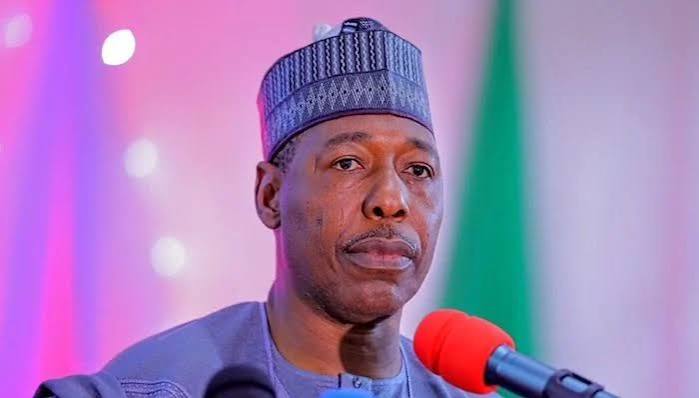
Borno State Governor Babagana Zulum has raised concern over the number of children still out of school in the state, revealing that approximately 800,000 children remain without access to formal education despite a decline from an earlier estimate of more than two million.
Zulum made the disclosure on Thursday when he received a delegation of the African Union led by Ambassador Jainaba Jagne, the Commission Chairperson’s Special Envoy for Children Affected by Armed Conflict, at the Government House in Maiduguri.
The governor attributed the persistent education challenge to years of insurgency, which disrupted schooling, displaced families and exposed children to difficult living conditions across parts of the state.
The prolonged conflict in northeastern Nigeria has damaged educational infrastructure, forced schools to close and made it difficult for many families to maintain access to basic services. In affected communities, insecurity and displacement have also disrupted children’s learning and their prospects for long-term development.
Zulum’s latest figure suggests a substantial reduction from the initial estimate of more than two million out-of-school children. However, the reported 800,000 figure remains a significant challenge for a state seeking to rebuild communities affected by years of violence.
During the meeting, the governor stressed the need to expand educational opportunities, particularly for girls, while strengthening youth empowerment and peacebuilding initiatives.
Improving access to education is widely regarded as an important component of recovery in conflict-affected communities. Schools can provide children with opportunities to acquire literacy, numeracy and vocational skills while offering a structured environment that supports their development.
For girls, barriers to education can include insecurity, poverty, displacement and social pressures. Addressing these challenges requires sustained investment in safe learning environments, qualified teachers, school facilities and support for vulnerable households.
The governor’s engagement with the African Union delegation also points to the importance of cooperation between state authorities and international institutions in addressing the long-term effects of armed conflict on children.
Beyond reopening classrooms, the scale of the challenge will require measures to identify children who have never enrolled, support those whose education has been interrupted and help young people acquire skills relevant to employment and community development.
The reported number of children still out of school highlights the distance Borno must cover to ensure that years of insecurity do not permanently deprive another generation of educational opportunities.