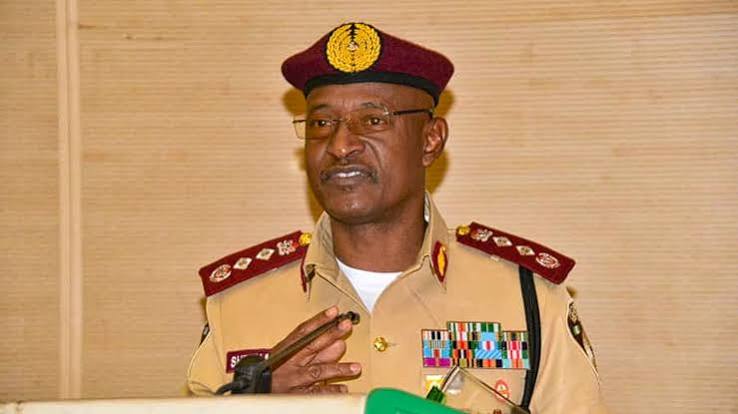
Retired pioneer officers of the Federal Road Safety Corps (FRSC) have appealed to President Bola Ahmed Tinubu and the Corps Marshal, Shehu Mohammed, to formally recognise the corps’ founder, retired Major Rasaki Salawu, and the 25 pioneer officers who helped establish the organisation.
The retired officers are also asking the Federal Government and the FRSC leadership to consider allocating special recruitment opportunities to the children and wards of the pioneers, citing the contributions their families made to the development of road safety administration in Nigeria.
The appeal was contained in a statement signed on behalf of the retired officers by Deacon Sunday Dairo, a retired senior FRSC officer who served in the corps’ zonal operations covering Oyo, Osun and Ondo states.
Dairo urged the authorities to accord Salawu national recognition comparable to the honour given to the late Pa Taiwo Akinkunmi, the designer of Nigeria’s national flag, by former President Goodluck Jonathan.
He said recognising the FRSC founder and the officers who helped establish its operations would preserve an important part of the institution’s history and acknowledge the contributions of those who laid its operational foundations.
How the FRSC Initiative Began
According to Dairo, Salawu conceived the Accidents Prevention Corps, popularly known as “Maja Maja”, in the then Oyo State in 1977, following his retirement from military service.
The initiative was designed to address road accidents and improve traffic safety. Its development later provided a model for the establishment of a federal road safety institution.
Dairo explained that the Oyo State accident prevention scheme received formal approval in August 1987 under the military administration of Major-General David Jemibewon.
In 1988, the Federal Government under the military administration of Ibrahim Babangida established the Federal Road Safety Commission, with Salawu serving as its pioneer Director of Operations.
The retired officers said the transition from the state-level initiative to a national institution demonstrated the significance of the early work undertaken by Salawu and his colleagues.
They also recalled that 25 personnel from the former Oyo State Road Safety Corps were released to the newly established federal body to support its initial operations.
According to the account provided by Dairo, the officers helped train the first batch of 1,000 youth corps members and contributed to the commencement of the organisation’s operational activities.
Retired Officers Seek Formal Recognition
The pioneers said formal recognition would help ensure that the contributions of the founding personnel were not forgotten as the FRSC continued to develop.
Dairo disclosed that only 11 of the original 25 pioneer officers were still alive, while 14 had died.
He appealed to the Corps Marshal to invite the surviving officers to the FRSC headquarters for formal recognition and an official engagement with the corps leadership.
The request, he explained, was intended to acknowledge the sacrifices made by the officers during the formative years of the organisation.
The retired officers also called for consideration to be given to their children and wards during future recruitment exercises.
Dairo said many of the pioneers were now living on modest pensions, while some of their children, despite having completed their education, remained unemployed.
He argued that employment opportunities for qualified children and wards would provide some relief to the families while recognising the contributions of the retired officers.
The request, however, is an appeal by the retired personnel and does not constitute an existing recruitment entitlement or a confirmed government policy.
Appeal for Support and Institutional Memory
The retired officers maintained that their request was not solely about employment but also about preserving the history of the FRSC and acknowledging those who contributed to its establishment.
They urged Tinubu and Mohammed to consider institutionalising a formal recognition programme for Salawu and the pioneer officers.
They also called for a response to their request for special recruitment consideration for their children and wards.
The appeal comes amid broader discussions about institutional history, public service and the welfare of retired personnel who contributed to the development of Nigeria’s public institutions.
For the retired pioneers, formal recognition would serve both as an acknowledgement of past service and as a reminder that the contributions of founding personnel remain part of the FRSC’s legacy.