Nigeria’s fight against drug abuse has taken a major leap as operatives of the National Drug Law Enforcement Agency (NDLEA) uncovered a sophisticated illegal laboratory manufacturing Colorado, a dangerous synthetic cannabis variant, inside a residential apartment in Ajao Estate, Isolo, Lagos. The discovery stunned even the agency’s officials, who believe the local production of this psychoactive substance is now expanding rapidly across the country. The suspect behind the laboratory, a 30-year-old man identified as Stephen Kelechi Imoh, was arrested after a well-coordinated raid that followed months of undercover surveillance and intelligence reports. Inside the house, officers found freshly produced batches of the drug and several industrial chemicals used in its manufacture, confirming that the property had been completely converted into a chemical processing plant disguised as a home.
NDLEA spokesperson, Femi Babafemi, described the breakthrough as a strong indication that synthetic cannabis is gradually shifting from importation to local production. He explained that the operation was triggered earlier in the year after officers at Lagos ports intercepted suspicious consignments of Colorado, revealing a new pattern of trafficking that suggested homegrown sources. What officials found during the raid aligned perfectly with those fears: drums of hazardous chemicals, large quantities of freshly cooked Colorado and a suspect believed to be a key player in a growing criminal network targeting mostly young Nigerians.
While the Lagos laboratory dominates headlines, it is only a fraction of the agency’s expanding operations within the past week. Another major arrest was recorded in Mushin, Lagos, where NDLEA operatives captured a well-known dealer, 28-year-old Afeez Salisu, widely recognized by the nickname Malu. He was found in possession of a significant quantity of Colorado products packaged in designer branding, as well as compressed blocks of Ghana Loud cannabis believed to be sourced from international suppliers.
More surprisingly, entertainment also found its way into the ongoing drug crackdown. A budding musician, 20-year-old Godspower George Osahenrumwen, popularly known as Steady Boy, was arrested after arriving in Lekki to receive a shipment of Loud cannabis smuggled into the country from New York. The psychoactive substances were hidden inside three cartons of imported bathtubs delivered through a courier service to the Lagos international airport. According to NDLEA, the young artist was allegedly picking up the consignment on behalf of a syndicate led by his manager, who has since fled from authorities.
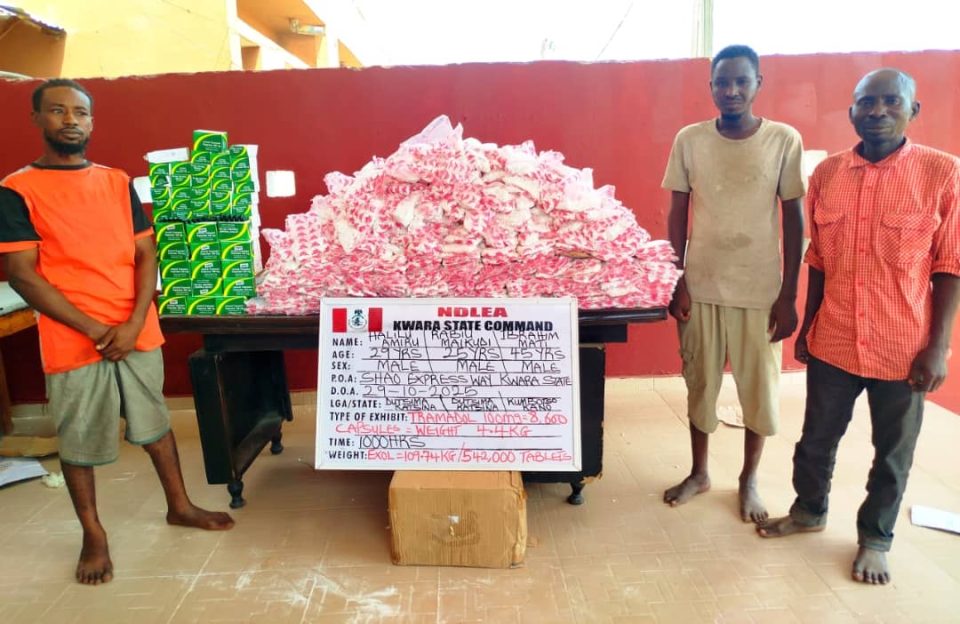
Beyond Lagos, the NDLEA intensified its surveillance along major highways in the North where multiple arrests were made. A large haul of tramadol capsules was intercepted along the Abuja–Jos expressway, leading to the apprehension of a suspected distributor in Bauchi. In Kaduna and surrounding areas, officers nabbed several traffickers transporting huge quantities of new psychoactive substances, including Akuskura and skunk, all heading into communities where drug addiction is dangerously rising.
The wave of enforcement continued in Ogun State, where three suspects were tracked from the Benin Republic and caught in Abeokuta with a truckload of skunk weighing over a ton. Similar victories were recorded in Bauchi and Kwara States, where various quantities of cannabis and controlled pharmaceutical drugs were seized from transporters attempting to ferry them across state borders. In Edo and Ondo States, more bulk seizures of skunk were reported, along with the arrest of individuals believed to be deeply rooted in the distribution chain.
The agency further revealed arrests in both Lagos and Taraba involving suspects dealing in skuchies and methamphetamine, two high-risk substances now gaining popularity among youths. Babafemi expressed strong concern that drug cartels are increasingly targeting unemployed young people, exploiting their skills, connections and desperation to fuel the booming black market for synthetic drugs.
Colorado, the substance at the center of these operations, has been linked to severe mental health problems, psychotic episodes, respiratory failure and, in some cases, irreversible brain damage. It is produced using harmful chemical compounds that can pose immediate life-threatening risks to users. Public health experts warn that its rising popularity could lead to a new level of substance abuse crisis in the country.
Reacting to the success of the clampdown, NDLEA reaffirmed its commitment to dismantling drug production networks operating in residential neighborhoods across Nigeria. The agency urged community members to remain vigilant and report suspicious activities that may endanger lives around them. Babafemi warned that anyone aiding or protecting drug dealers will face the full weight of the law, noting that the agency is determined to stay ahead of criminal tactics being adopted by syndicates.
The arrests and seizures of the past week highlight the NDLEA’s increasingly aggressive strategy in confronting the nation’s drug epidemic. As intelligence continues to uncover new hideouts and methods used by traffickers, authorities insist that the war on drugs is far from over. With synthetic cannabis laboratories now appearing in Lagos neighborhoods, the NDLEA says it is racing against time to prevent a full-blown public health disaster driven by toxic chemicals disguised as recreational highs.