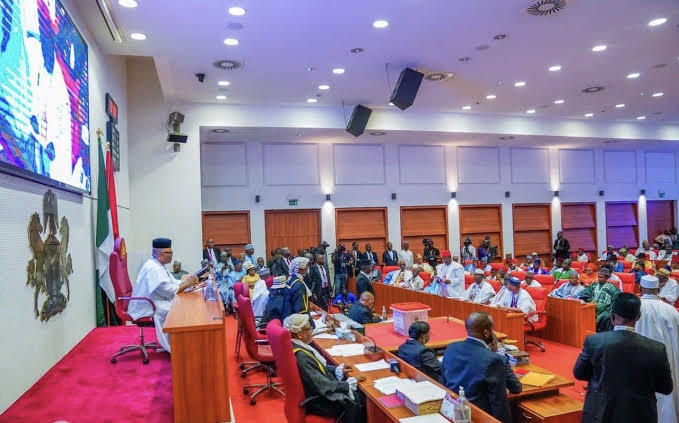
The Senate’s ad-hoc committee investigating crude oil theft has raised alarm over the disappearance of about N300 billion in proceeds from domestic crude sales, a revelation that has stirred intense public reaction. Presenting its interim findings to lawmakers, the panel reported widespread irregularities and data inconsistencies across Nigeria’s oil revenue system, describing the situation as a deep-rooted accountability failure.
According to the committee, its investigation was conducted through document audits, public hearings, written submissions and consultations with international experts. The exercise identified systemic loopholes in revenue tracking dating as far back as 2015. A forensic review of domestic crude revenues and tax oil proceeds revealed financial mismatches amounting to roughly $22 billion. The panel also uncovered an $81 billion discrepancy between crude oil receipts declared by the Nigerian National Petroleum Company Limited and those recorded by the Central Bank of Nigeria between 2016 and 2017. In addition, assessments supported by foreign consultants projected that more than $200 billion in proceeds from Nigeria’s crude exports across global markets have never been properly accounted for.
The committee attributed the situation to weak oversight, poor interagency coordination, and problematic measurement systems. It cited the continued use of unverified metering devices, inadequate metrological standards, and fragmented enforcement mechanisms as key enablers of large-scale revenue diversion. One of the policy failures highlighted was the suspension of the Weights and Measures Department’s role in upstream operations following the Petroleum Industry Act 2021. The panel said this decision undermined transparency and accuracy in crude measurement, further widening the gap in revenue accountability. It also emphasized the absence of a special court dedicated to prosecuting oil theft cases and condemned the non-implementation of the Host Communities Development Trust Fund as factors fueling sabotage and insecurity in oil-producing regions.
To restore transparency, the committee recommended an immediate national and international recovery effort to trace stolen funds. It urged the Federal Government to mandate the Nigerian Upstream Regulatory Commission to enforce global measurement standards at production sites and export terminals, or alternatively reinstate the Weights and Measures Department. The panel further advised the deployment of modern surveillance equipment, including unmanned aerial vehicles, to boost security around critical oil facilities and detect theft activities in real time. It proposed the creation of a Maritime Trust Fund to strengthen maritime operations, alongside the establishment of a special court to accelerate the prosecution of crude oil theft and related crimes. The committee also raised concerns about abandoned and poorly decommissioned oil wells across the Niger Delta, saying many of them leak crude and gas into the environment. It recommended that such wells be transferred to the NUPRC and handed over to modular refineries, which would help increase crude availability for domestic processing and reduce vandalism.
Despite the revenue crisis, the report noted modest improvement in production levels. Nigeria’s crude output increased by 9.5 percent from 490.95 million barrels in 2022 to 537.57 million barrels in 2023, a development the committee attributed to enhanced security conditions. The panel, reconstituted on February 11, 2025, after the death of its former chairman Senator Ifeanyi Ubah, also asked the Senate to grant it full authority to track and recover stolen crude revenue globally. It argued that reclaiming the funds is critical to rebuilding accountability, strengthening fiscal stability and deterring future theft.
In response, the Senate commended the committee’s efforts but clarified that asset recovery is not its mandate. Lawmakers directed the panel to complete its investigation, name those involved in crude theft, and submit its recommendations to the Executive for action. The revelations have sparked a mix of anger, disappointment and indifference among Nigerians, with many calling for drastic measures to prevent further economic losses. Oil analyst Idowu Christopher said the findings merely confirm what has long been known about corruption in the sector. He accused authorities of knowing the culprits but choosing inaction, questioning how individuals continue to own oil wells—resources he described as public assets—without consequences. Christopher praised the committee’s recommendation to reclaim such wells and transfer them to modular refineries through the NUPRC, adding that the government’s failure to implement the Host Communities Development Trust Fund has encouraged sabotage and theft.
Legal analyst Chikia Umeayo, however, expressed resignation rather than outrage. He argued that such revelations have become routine and that many experts have raised similar concerns for years without any meaningful response. Umeayo said he no longer invests emotional energy in such findings, insisting that investigations often end without accountability and that he expects nothing different from the current probe.