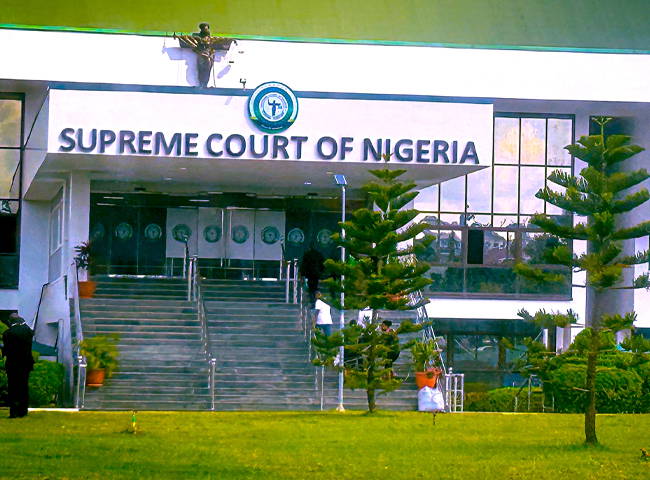
The Supreme Court has affirmed the constitutional powers of the President to declare a state of emergency in any part of the country and, where necessary, suspend elected officials for a limited period to prevent a breakdown of law and order.
In a split decision of six to one delivered on Monday, December 15, 2025, the apex court held that the President is empowered under Section 305 of the 1999 Constitution (as amended) to take extraordinary measures to restore peace and stability during a declared state of emergency.
Delivering the lead judgment, Justice Mohammed Idris ruled that the Constitution grants the President wide discretionary powers once a state of emergency is proclaimed, noting that the law does not expressly limit the nature of actions that may be taken to restore normalcy.
According to the court, such measures may include the temporary suspension of elected state officials, provided the action is time-bound and aimed at preventing chaos or anarchy.
The judgment arose from a suit filed by governors elected on the platform of the Peoples Democratic Party (PDP), who challenged President Bola Tinubu’s declaration of a state of emergency in Rivers State, during which elected officials were suspended for six months.
The plaintiffs, represented by the Attorneys-General of Adamawa, Enugu, Osun, Oyo, Bauchi, Akwa Ibom, Plateau, Delta, Taraba, Zamfara and Bayelsa states, argued that the President lacked constitutional authority to suspend a democratically elected state government or dissolve a State House of Assembly under the guise of emergency rule.
They asked the Supreme Court to interpret several provisions of the Constitution, including Sections 1, 4, 5, 11, 176, 180, 188 and 305, and to determine whether the procedure adopted in Rivers State violated constitutional safeguards.
However, the apex court upheld preliminary objections raised by the Attorney-General of the Federation and the National Assembly, ruling that the plaintiffs failed to establish a justiciable dispute capable of invoking the court’s original jurisdiction.
Justice Idris held that the suit disclosed no actionable cause and accordingly struck it out for want of jurisdiction.
In a dissenting opinion, Justice Obande Ogbuinya agreed that the President possesses the power to declare a state of emergency but disagreed that such authority extends to suspending elected governors, deputy governors or members of state legislatures, describing such actions as unconstitutional.
The ruling has far-reaching implications for the balance of power between the federal government and the states, particularly in times of national security and governance crises.