US President Donald Trump has sharply escalated tensions with Venezuela, announcing what he described as a maritime blockade targeting sanctioned oil tankers linked to the South American nation.
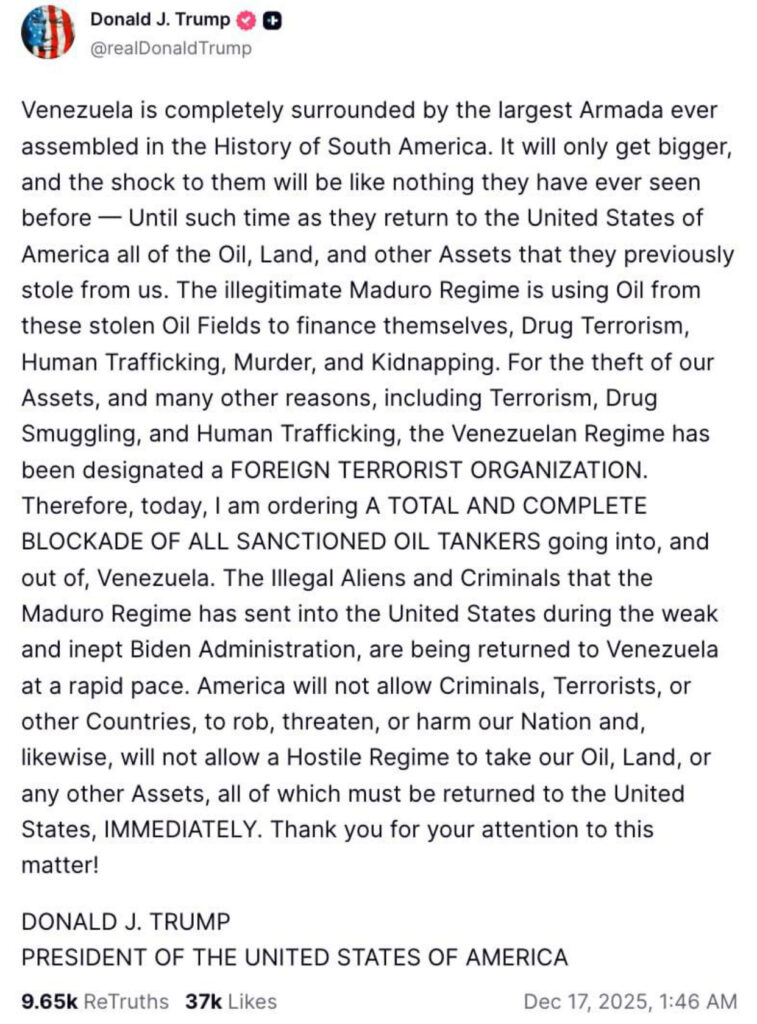
In a lengthy statement posted on his social media platform, Trump said Venezuela was now “surrounded” by an unprecedented American naval presence in the region. He accused the Venezuelan government of illegally taking oil, land and other assets from the United States, and warned that pressure would intensify until those assets were returned.
“Venezuela is completely surrounded by the largest armada ever assembled in the history of South America,” Trump wrote. “It will only get bigger, and the shock to them will be like nothing they have ever seen — until they return to the United States all of the oil, land and other assets they previously stole.”
Trump did not specify which land or oil assets he was referring to. However, analysts note that under former Venezuelan president Hugo Chávez, the government nationalised oil fields in 2007, a move that led to the expropriation of assets belonging to several American energy companies.
As part of the new measures, Trump announced what he called a “total and complete blockade” of sanctioned oil tankers entering or leaving Venezuelan waters. The declaration signals a tougher stance aimed at choking off oil revenues that Washington believes are sustaining President Nicolás Maduro’s government.
The Venezuelan government swiftly pushed back, describing Trump’s comments as dangerous and unlawful. In a strongly worded statement, officials in Caracas said the announcement amounted to a reckless threat that violated international law, freedom of navigation and global trade norms.
“The President of the United States intends to impose, in an absolutely irrational manner, a supposed naval military blockade on Venezuela with the objective of stealing the wealth that belongs to our homeland,” the statement said.
While the United States currently has 11 warships operating in the Caribbean — its largest regional naval presence in decades — military experts say that would still fall short of enforcing a traditional blockade, which typically requires the full sealing of a country’s coastline.
According to Reuters, roughly 30 sanctioned vessels are involved in transporting Venezuelan oil. Data from Tanker Trackers also indicates that more than a dozen sanctioned tankers are currently operating in Venezuelan waters.
The renewed tension follows recent US actions in the region. Last week, American authorities seized a sanctioned oil tanker off Venezuela’s coast, alleging it was part of an illicit network transporting oil between Venezuela and Iran, with the seized shipment reportedly bound for Cuba.
Separately, the US military has carried out dozens of operations since September targeting vessels suspected of drug trafficking in the Caribbean — efforts the Trump administration says are aimed at curbing narcotics entering the United States.
Trump’s latest comments also follow remarks attributed to White House Chief of Staff Susie Wiles, who was quoted by Vanity Fair as saying Trump was prepared to intensify maritime operations until President Maduro “cries uncle.”
In his statement, Trump once again labelled the Maduro government a “hostile regime,” reinforcing his administration’s hardline position against Caracas. While Washington has long accused Maduro of authoritarian rule and corruption, Trump last month took the unprecedented step of designating the Venezuelan leader as the head of a foreign terrorist organization.
“The illegitimate Maduro regime is using oil from these stolen fields to finance drug terrorism, human trafficking, murder and kidnapping,” Trump wrote, citing those allegations as justification for the tougher measures.
The latest developments are likely to further strain already fragile relations between Washington and Caracas, raising fresh concerns about regional stability and the potential impact on global energy markets.