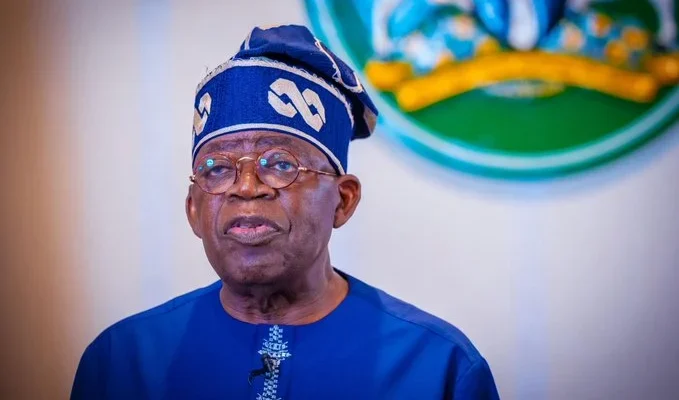
President Bola Ahmed Tinubu has said that Nigeria is entering a more robust phase of economic growth, expressing optimism that reforms implemented over the past year will deliver broader prosperity in 2026.
The President stated this in his New Year address to the nation on Thursday, where he reviewed economic and security developments in 2025 and outlined policy priorities for the year ahead.
According to Tinubu, Nigeria recorded steady economic progress in 2025 despite global economic challenges. He said the country sustained quarterly gross domestic product growth throughout the year, with annualised growth expected to exceed four per cent.
He added that Nigeria maintained trade surpluses and achieved improved exchange-rate stability, while inflation declined steadily and fell below 15 per cent, in line with government targets. Tinubu said the administration aims to further reduce inflation in 2026 and ensure that the benefits of reforms reach Nigerian households.
The President also highlighted the performance of the Nigerian Stock Exchange, which he said gained 48.12 per cent in 2025, outperforming several peer markets. He attributed the performance to improving investor confidence and sound monetary policy management.
Nigeria’s foreign reserves stood at $45.4 billion as of December 29, 2025, Tinubu said, noting that the reserve position provides a buffer against external shocks to the naira and is expected to strengthen further in the new year.
On foreign investment, Tinubu disclosed that foreign direct investment rose sharply to $720 million in the third quarter of 2025, compared with $90 million in the previous quarter. He said the increase reflects renewed investor confidence in Nigeria’s economic direction, which has been acknowledged by international credit rating agencies, including Moody’s, Fitch and Standard & Poor’s.
The President said his administration would focus in 2026 on consolidating economic gains while building a resilient, inclusive and sustainable economy. He noted that moderating inflation and interest rates are expected to create more fiscal space for investment in infrastructure and human capital development.
Tinubu also addressed tax reforms, describing multiple taxation as a major challenge across all levels of government. He commended states that have adopted harmonised tax laws under the national tax harmonisation agenda, aimed at reducing the burden of taxes, levies and fees on citizens and businesses.
He said the new year marks a critical phase in implementing tax reforms designed to strengthen Nigeria’s fiscal base, improve revenue generation and support infrastructure and social investments.
The President recalled that he recently presented the 2026 Appropriation Bill to the National Assembly, stating that the budget builds on reforms intended to ensure long-term economic stability and growth.
On security, Tinubu said economic progress must be supported by peace and stability, noting that Nigeria continues to face threats from criminal and terrorist groups. He disclosed that, in collaboration with international partners including the United States, security forces carried out targeted operations against terrorist elements in parts of the North-West on December 24.
He added that the Armed Forces have continued operations against terrorist and criminal networks across the North-West and North-East, and said security and intelligence agencies would deepen cooperation with regional and global partners in 2026.
The President reaffirmed his support for a decentralised policing system, with appropriate safeguards and regulated forest guards, as part of efforts to address terrorism, banditry and related security challenges.
On development at the grassroots, Tinubu said the government would accelerate the Renewed Hope Ward Development Programme, which aims to engage at least 10 million Nigerians in productive economic activities by empowering a minimum of 1,000 people in each of the country’s 8,809 wards.
He said investments in infrastructure—including roads, power, ports, railways, airports, healthcare, education and agriculture—would continue without interruption, with a focus on improving food security and living standards.
Tinubu urged Nigerians to embrace unity, patriotism and collective responsibility in nation-building, stressing that achieving the government’s objectives in 2026 would require the cooperation of all citizens.
He concluded by wishing Nigerians a peaceful and prosperous New Year and reaffirmed the government’s commitment to protecting lives, property and the country’s territorial integrity.