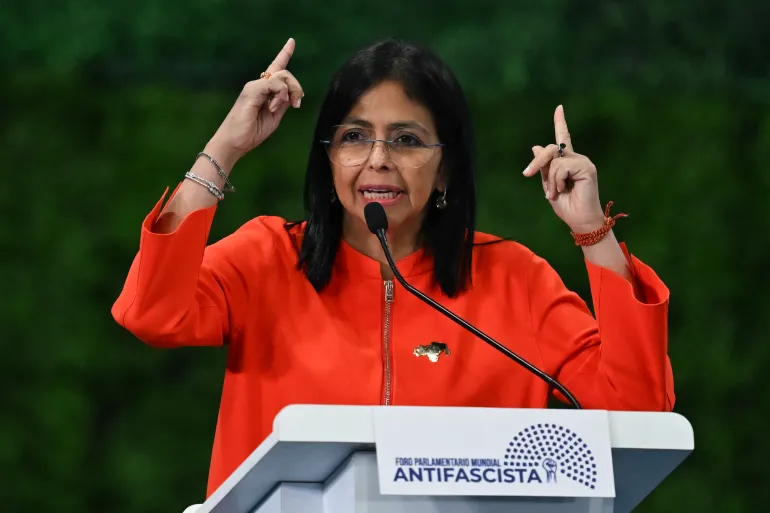
Venezuela’s Supreme Tribunal of Justice (TSJ) has appointed Vice President Delcy Rodríguez as acting president following the capture of President Nicolás Maduro by United States forces.
The ruling was issued by the Constitutional Chamber of the court and read publicly by its president, Caryslia Beatriz Rodríguez, during a broadcast on state television network Venezolana de Televisión (VTV).
According to the court, Maduro’s capture constitutes a situation of “material and temporary impossibility” preventing him from carrying out his constitutional duties as president.
“In light of the exceptional situation created by the kidnapping of Nicolás Maduro Moro, President of the Republic, which constitutes a case of material and temporary impossibility to exercise his functions, the Executive Vice President of the Republic is hereby ordered to assume and exercise, in an acting capacity, all powers and duties inherent in the office of President,” the ruling stated.
The court said the decision was necessary to ensure administrative continuity, national security, and the overall defence of the Venezuelan state. It added that the circumstances amounted to force majeure, posing a serious threat to governance and stability, even though such conditions are not explicitly outlined in the country’s constitution.
The Constitutional Chamber described the move as an “urgent and preventive protective measure” aimed at safeguarding the functioning of the government amid the unfolding crisis.
Shortly after the announcement, Brazil’s Ministry of Foreign Affairs issued a statement formally recognising Rodríguez as Venezuela’s interim leader.
“We recognise Venezuelan Vice President Delcy Rodríguez as the acting president of Venezuela, in light of the absence of President Nicolás Maduro, who is currently being held in the United States,” the statement said.
Maduro and his wife, Cilia Flores, were reportedly captured during a surprise pre-dawn raid by US special forces in Caracas. Reports indicate that the pair were arrested at their residence within the heavily guarded Fort Tiuna military complex.
On January 3, 2026, the United States launched what it described as a decisive military operation against Venezuela, with the Trump administration saying the action was aimed at apprehending Maduro and transferring him to the US to face criminal charges.
The development has further intensified political uncertainty in Venezuela and drawn sharp international reactions, as questions mount over the country’s leadership and the legality of the US intervention.