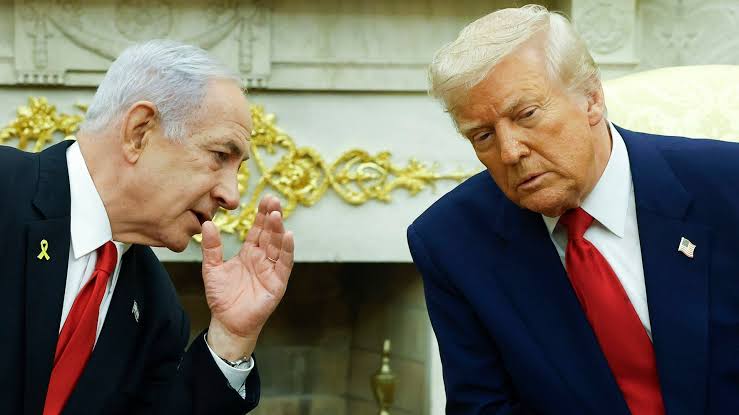
Israeli Prime Minister Benjamin Netanyahu reportedly persuaded United States President Donald Trump to suspend planned air strikes on Iran during a tense, last-minute phone call, as preparations for a potential regional confrontation intensified.
According to a report by The New York Times, military and diplomatic signals in the region suggested that an attack on Iran was imminent, with diplomatic staff evacuated from Tehran and airspace restrictions reportedly put in place. The situation was said to have shifted after Netanyahu urged Trump to delay any military action to give Israel more time to prepare for possible Iranian retaliation.
Shortly after the reported intervention, Trump publicly stated that he had received intelligence from what he described as “very important sources on the other side,” indicating that Iran had halted the execution of dissidents.
“We were told that the killing in Iran is stopping, and there’s no plan for executions,” Trump said. “There’s no plan for executions or an execution. I’ve been told that on good authority. We’ll find out about it.”
On Thursday, January 15, the White House announced that approximately 800 executions in Iran had been halted, adding that Trump was closely monitoring developments. In a phone interview with NBC News, Trump claimed that decisive action had helped avert further loss of life, saying, “We saved a lot of lives yesterday.”
Iranian Foreign Minister Abbas Araghchi later told Fox News that there were no plans for the execution of protesters, pushing back against reports of imminent mass hangings.
Regional powers, including Qatar, Saudi Arabia, Oman and Egypt, were also said to have appealed to Washington to avoid military action against Iran, warning that an attack could trigger a broader and more destabilising conflict across the Middle East.
Meanwhile, Iran continues to grapple with widespread anti-government protests and mounting international criticism over its response. The government has reportedly shut down nationwide internet access, while two Iranian officials cited by The New York Times claimed that at least 3,000 people had died during the unrest.
Mahmood Amiry-Moghaddam, director of Iran Human Rights, described the situation as dire, citing eyewitness accounts of protesters being shot while attempting to flee and the use of military-grade weapons against civilians.
“These accounts point to a planned and widespread crime carried out with the aim of mass killing civilians,” he said, calling on the international community to act urgently to prevent further loss of life.
Attention has also focused on the case of Erfan Soltani, a 26-year-old shopkeeper detained during protests and initially believed to be at risk of execution. His family had warned that he could be executed at any moment, sparking international concern.
However, Iran’s state-controlled media later reported that the charges against Soltani — including alleged collusion against internal security and propaganda activities — do not carry the death penalty if upheld by a court, suggesting a possible de-escalation in his case.
The developments highlight the fragile balance between diplomatic intervention and escalating tensions as the international community watches closely for Iran’s next move.