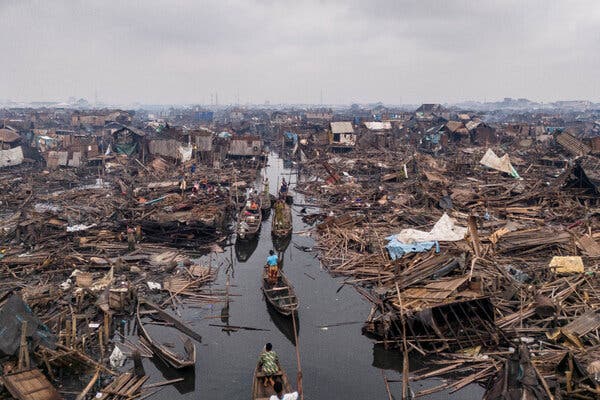
Makoko, the historic waterfront fishing settlement in Lagos, has been plunged into a deep humanitarian crisis following an ongoing demolition exercise by the Lagos State Government that has left thousands of residents homeless and struggling to survive.
Entire stretches of wooden homes and shops have been pulled down across the lagoon community, forcing families — including women, children, widows and the elderly — to sleep in canoes, under open skies and along the water’s edge. Scattered planks, ruined household items and abandoned fishing gear now litter the once-bustling settlement.
Often described as Africa’s largest floating community, Makoko is home to generations of fishermen, traders and artisans whose livelihoods depend entirely on the lagoon. For many, the demolition has not only destroyed their homes but also wiped out their only source of income.
Demolition began quietly in December
Residents revealed that the demolition started quietly in parts of Makoko in December 2025 before escalating significantly in January.
“They started from one side and kept moving,” said Mr Sunday Adebayo, a community elder who has lived in Makoko for more than 20 years. “At first, we thought it would stop. But by January, it became massive. That’s when we knew they wanted to wipe us out.”
For families who survived through fishing and small trading activities run from their homes, the impact has been devastating.
“This water is our life,” said Oyomide, a 35-year-old fisherman. “I go fishing, my wife smokes fish and we sell. When they destroyed the house, everything ended. My net was damaged, my canoe almost sank. We don’t eat well anymore.”
A mother of four described hunger as a daily reality. “Sometimes my children sleep without food. As a mother, it pains me deeply. Every night I cry, wondering how to raise my children.”
Several residents said they lost cash savings, fishing tools and personal belongings during the exercise, claiming they were given little or no time to evacuate.
No shelter, no relief
Displaced residents said no temporary shelter or Internally Displaced Persons (IDP) camp has been provided by the state government. Many now endure harsh weather conditions, mosquito infestations and rising illness.
“When rain falls, we are soaked. When the sun comes out, there is no shade,” one resident said. “At night, we hold our children tightly inside canoes.”
Parents also reported withdrawing their children from school due to the loss of uniforms, books and money for transport. Teachers in nearby schools confirmed a sharp drop in attendance from Makoko pupils since January.
Allegations of deaths and overnight demolitions
Residents and civil society groups alleged that at least 12 deaths may be linked to the demolition, citing stress, trauma and illness following displacement. While the Lagos State Government has not confirmed the figures, families insist the losses are real.
“My brother was healthy,” said Ibrahim Lawal. “After our house was destroyed, he fell sick. We had nowhere to sleep and no money for treatment. He died quietly.”
Some residents also alleged that demolitions were carried out overnight, with bulldozers moving in while families were asleep. Others claimed that certain structures were set ablaze, forcing occupants to flee with nothing.
Government insists on safety grounds
The Lagos State Government has defended the exercise, saying the demolished structures were built under high-tension power lines and posed a serious safety risk.
Governor Babajide Sanwo-Olu said the buildings had long been marked and that the exercise was necessary to prevent loss of lives. He also stated that compensation was being arranged for affected residents.
However, many residents disputed the government’s justification, insisting that several demolished homes were located far from high-tension cables.
“How can they say it’s about safety when houses more than 500 metres away were destroyed?” asked Mrs Funke Olawale, whose home and shop were pulled down.
Assembly backs demolition amid backlash
The Lagos State House of Assembly has thrown its weight behind the demolition, describing it as necessary for public safety and urban development.
But residents say the political backing has deepened their sense of abandonment.
“We protested and cried, but they didn’t listen,” said Mr Adewale, a youth leader in Makoko. “They say development must continue, even if it destroys our lives.”
The crisis has also sparked national debate, with former Education Minister Oby Ezekwesili condemning the demolitions as inhumane and unconstitutional, while other political figures have called for dialogue and humane resettlement.
As night falls on Makoko, fear and uncertainty hang over the lagoon community. With no clear resettlement plan and livelihoods destroyed, residents say they are left floating between loss and an uncertain future — a stark reminder of how urban development, when poorly managed, can deepen human suffering.