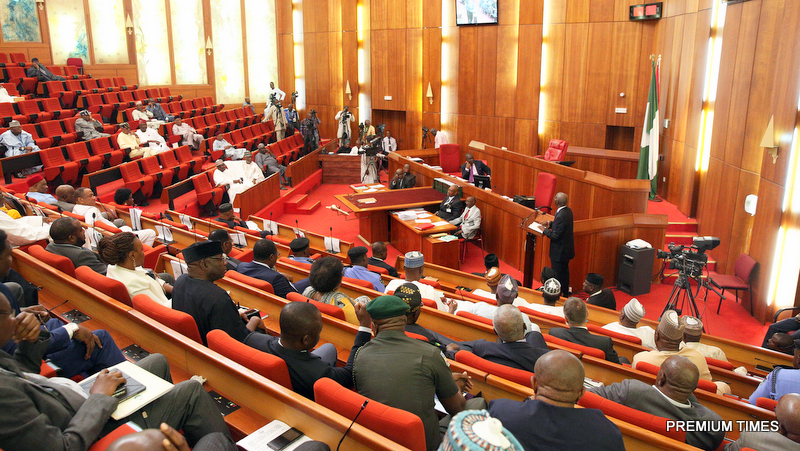
The Senate’s decision to advance a bill prescribing the death penalty for kidnappers has triggered widespread debate, drawing criticism from human rights advocates, legal scholars and some community leaders who argue that capital punishment will not curb the country’s escalating insecurity.
Nigeria continues to grapple with rampant banditry and kidnapping, crimes that have claimed thousands of lives and inflicted severe economic damage. Earlier this week, lawmakers passed for second reading the Terrorism (Prevention and Prohibition) Amendment Bill, 2025 (SB.969), which seeks to classify kidnapping and hostage-taking as acts of terrorism, impose the death penalty on offenders and empower security agencies to trace and seize assets linked to such crimes.
Senate Leader Opeyemi Bamidele, who sponsored the bill with the backing of all 108 senators, said the amendments respond directly to one of Nigeria’s gravest security concerns. He described kidnapping as a “commercialised, militarised and coordinated national menace” that has overwhelmed families, crippled businesses and overstretched security agencies.
According to him, classifying kidnapping as terrorism will grant law enforcement broader powers under counterterrorism frameworks, enabling quicker prosecution and improved disruption of criminal financing networks.
The bill received cross-party support, with many senators calling it overdue. Senate Chief Whip, Tahir Monguno, highlighted the bill’s legal reforms, including enhanced training for lawyers and expanded powers for the Legal Practitioners Disciplinary Committee to address misconduct.
Human rights experts warn Nigeria may breach global obligations
Despite broad legislative backing, the proposal has drawn strong criticism from several quarters.
Foremost among them is Prof. Uchenna Emelonye, a human rights scholar at Bournemouth University and former UN Senior Human Rights Envoy. He argued that expanding the death penalty contradicts Nigeria’s commitments under the International Covenant on Civil and Political Rights (ICCPR), which the country ratified in 1993.
Emelonye said the amendment is “regressive, ineffective and legally questionable,” insisting there is no credible evidence that capital punishment deters kidnapping or violent crime. He warned that Nigeria’s criminal justice system, with its high error rates, weak investigations and reliance on coerced confessions, risks wrongful executions.
He noted that several African nations—including Sierra Leone, Rwanda, Burundi, Zambia and the Central African Republic—have abolished the death penalty without experiencing a surge in kidnapping, suggesting that execution is not an effective deterrent.
Emelonye urged lawmakers to pursue rights-based alternatives such as improved policing, intelligence gathering, justice-sector reforms, and stronger action against the proliferation of arms.
Calls for addressing root causes of insecurity
Other prominent voices, including Islamic scholar Sheikh Ahmad Gumi, argued that the government must confront the socio-economic drivers of kidnapping, including poverty, marginalisation and lack of opportunities. Gumi contended that punitive measures alone will worsen the situation and advocated dialogue, rehabilitation and social investment as more sustainable solutions.
On social media, critics questioned the fairness of Nigeria’s justice system, raising concerns about inconsistent sentencing, corruption and the potential for disproportionate punishment.
Legislative tensions over vote procedure
The bill also sparked procedural disagreements within the Senate. Some lawmakers, including Senator Adams Oshiomhole, objected to deciding the death penalty clause through a voice vote, insisting that such a consequential issue requires more rigorous deliberation.
Majority still backs death penalty as deterrent
Despite the pushback, most senators, along with several state governors and South-West leaders, maintain that the death sentence remains a necessary deterrent amid Nigeria’s deepening security crisis.
The bill is expected to return for further consideration in the coming weeks.