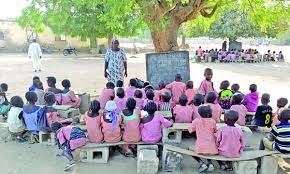
In the heart of Nigeria’s capital territory, a disturbing reality is unfolding in Rugan Wakili Buba, a rural community within Paiko Kore, Gwagwalada Area Council of the FCT. Pupils at the LEA Nomadic Primary School are forced to learn in the open air, sitting on bare ground beneath trees due to the total absence of classroom buildings, desks, and basic teaching materials.
This alarming situation came to light following an on-site assessment by civic tech platform Monitng, which decried the dilapidated state of education in the area. The platform described what it found as unacceptable and called on authorities to act immediately.
“Dozens of schoolchildren gather daily under a tree to learn—without classrooms, chairs, or any semblance of formal educational infrastructure. This is the educational condition in the Federal Capital Territory,” the organisation said.
Monitng has urged the Minister of the FCT, Nyesom Wike, and the FCT’s Senator, Ireti Kingibe, to urgently visit the area and initiate remedial action.
Despite the FCT Administration’s budgetary commitments to education, the school remains a ghost of what it should be. In rainy weather, lessons are suspended entirely. During dry spells, classes are held under trees or in makeshift spaces offered by sympathetic villagers. Many of the teachers present are community volunteers, as government-assigned educators have reportedly stopped reporting due to the deteriorating conditions.
“Education in Nigeria must go beyond rhetoric and token allocations. What we’re witnessing in Rugan Wakili Buba is a complete systemic failure,” Monitng stated. “These children are determined to learn, but they are being failed by a system that denies them the dignity of a classroom or trained instructors.”
The organisation stressed the urgent need for targeted interventions, warning that neglecting rural schools in the FCT could have far-reaching consequences for national development.
With no infrastructure, minimal support, and growing public concern, the situation at LEA Nomadic Primary School is a sobering reminder that access to education remains unequal—even at the doorstep of Nigeria’s administrative capital.