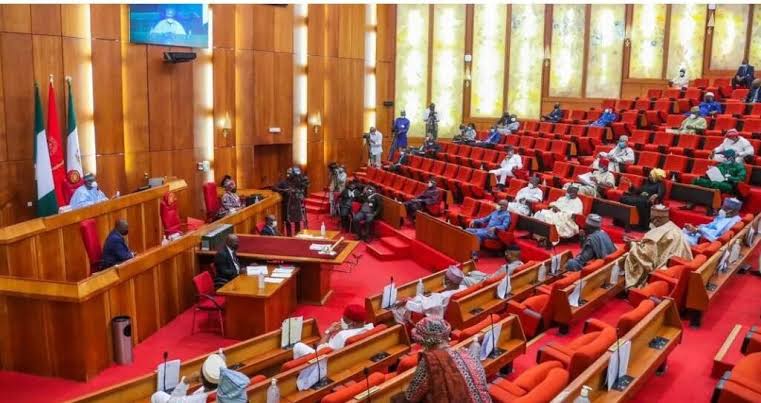
Public criticism has continued to mount against the Nigerian Senate following its amendment of the Electoral Act, with many Nigerians demanding that electronic transmission of election results be made mandatory without exceptions.
The controversy erupted after the upper chamber, presided over by Senate President Godswill Akpabio, adopted a revised provision permitting electronic transmission of results while allowing manual result sheets to prevail where electronic transmission fails due to network or communication issues.
Under the amendment, presiding officers are required to upload polling unit results to the Independent National Electoral Commission (INEC) Result Viewing Portal (IReV). However, in cases where electronic transmission is unsuccessful, the manual result sheet — Form EC8A — will serve as the primary document for collation and declaration of results.
The decision has drawn sharp reactions from civil society organisations, opposition figures, and legal experts, many of whom argue that the provision weakens recent electoral reforms and reintroduces vulnerabilities associated with manual processes.
Senate Defends Position
Responding to the backlash, Senate Spokesman Yemi Adaramodu said the National Assembly would not be intimidated by public pressure. Speaking on Channels Television’s Politics Today, he maintained that lawmaking requires deliberation and cannot be reduced to populism.
According to him, divergent opinions are part of democratic governance, and the Senate remains committed to considering all perspectives before finalising legislation.
Opposition, Civil Groups Raise Alarm
The National Coordinator of the Obidient Movement, Dr. Yunusa Tanko, criticised the amendment, warning that permitting manual transmission where electronic upload fails could trigger disputes at polling units and collation centres.
Tanko questioned claims by some lawmakers that poor network coverage in their constituencies justified the fallback to manual collation, arguing that infrastructure gaps should be addressed rather than used as a basis for weakening reform measures.
Similarly, former PDP National Auditor Ray Nnaji accused lawmakers of creating loopholes that could enable manipulation of election outcomes. He alleged that some legislators might resist stricter transparency measures out of concern for their political survival, insisting that public pressure must shape the final version of the law.
Barrister Olu Omotayo, President of the Civil Rights Realisation and Advancement Network (CRRAN), also faulted the timing of the amendment, stating that meaningful electoral reforms should not be pursued close to election cycles. He stressed the need for sustained investment in telecommunications infrastructure if electronic transmission is to function effectively nationwide.
Analysts Warn of Credibility Concerns
Public affairs analyst Nduka Odo described the Senate’s action as a step that could undermine electoral credibility. He argued that allowing flexibility between electronic and manual transmission could create inconsistencies in result collation, raising questions about transparency.
Odo called on Nigerians to demand stronger safeguards in the law, noting that confidence in the electoral process remains central to democratic stability.
Other prominent figures, including former Minister of Education Obiageli Ezekwesili, veteran actor Kenneth Okonkwo, and former Vice President Atiku Abubakar, have also expressed reservations about the amendment.
Harmonisation Committee Set Up
Meanwhile, Senate President Akpabio disclosed that a 12-member committee has been constituted to harmonise the Senate’s version of the bill with that of the House of Representatives.
He expressed optimism that once harmonisation is completed, President Bola Tinubu could assent to the amended Electoral Act within February.
The debate over compulsory electronic transmission is expected to remain a focal point of national discourse as stakeholders assess the potential implications of the amendment ahead of the 2027 general elections.