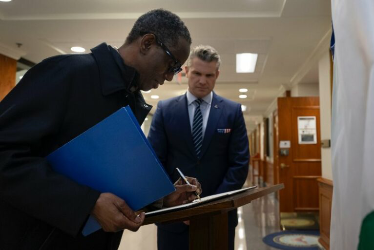
The United States has signaled growing alarm over violent attacks targeting Christians in Nigeria as Secretary of War Pete Hegseth met with Nigeria’s National Security Adviser, Nuhu Ribadu, at the Pentagon on Thursday. The high-level discussions focused on what U.S. officials describe as escalating atrocities carried out by jihadist groups across the northern and Middle Belt regions of Nigeria.
Hegseth highlighted the urgency of the situation in a post on his official X account, @SecWar, saying: “Yesterday, I met with Nigeria’s National Security Advisor and his team to discuss the horrific violence against Christians in their country. Under @POTUS leadership, DOW is working aggressively with Nigeria to end the persecution of Christians by jihadist terrorists.” Photos shared alongside the statement showed formal introductions and closed-door discussions between the delegations.
The meeting comes amid intensifying concerns about Nigeria’s security landscape. Boko Haram, the Islamic State’s West Africa Province (ISWAP), and armed Fulani militants have been implicated in repeated attacks on churches, rural farming communities, and schools. Human rights organizations, including Open Doors and the International Society for Civil Liberties and Rule of Law, warn that the death toll is rising sharply.
According to recent reports, more than 7,000 Christians were killed in Nigeria during the first seven months of 2025 alone, averaging more than 30 deaths per day. Victims have suffered from kidnappings, mass killings, and assaults on both places of worship and remote communities.
The talks also follow stern warnings from U.S. President Donald Trump, who has suggested possible American military intervention if Nigeria fails to control extremist violence. Trump has stated that U.S. forces could be deployed “guns-a-blazing” against Islamist militants if necessary.
Earlier this year, Nigeria was placed back on the U.S. list of “Countries of Particular Concern” for violations of religious freedom, reversing a previous delisting. The designation links future U.S. aid and cooperation to measurable progress in protecting vulnerable religious minorities.