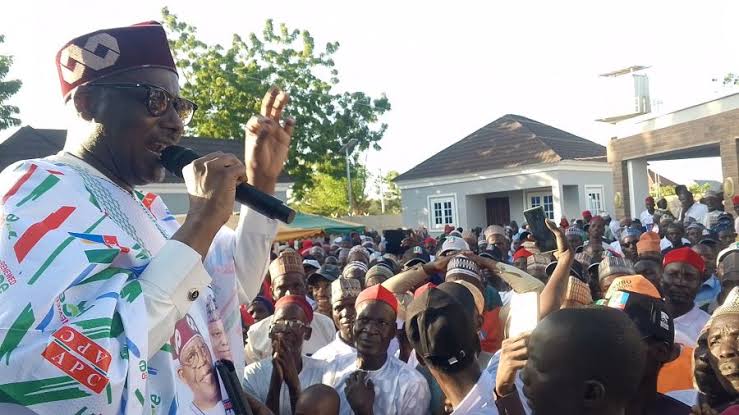
A chieftain of the All Progressives Congress (APC), Magaji Da’u Aliyu, has argued that Northern political leaders should support President Bola Tinubu’s re-election in 2027, claiming that the region previously agreed to back Tinubu’s presidential ambition after Muhammadu Buhari completed eight years in office.
Aliyu, a former member of the House of Representatives representing Birnin-Kudu/Buji in Jigawa State, made the remarks while addressing supporters in Birnin Kudu.
He also serves as Deputy Campaign Director of the North for Tinubu Support Group.
According to Aliyu, Northern political leaders approached Tinubu in Lagos before the 2015 presidential election to seek his support for Buhari’s ambition to become president.
He claimed that Tinubu agreed to support Buhari on the understanding that presidential power would return to Tinubu’s political camp after Buhari’s two terms.
Aliyu maintained that the alleged understanding should guide the position of Northern political leaders as the country approaches the 2027 general election.
His comments have brought renewed attention to the role of political alliances, regional interests and power-sharing expectations in Nigeria’s presidential politics.
The Alleged Agreement Behind the 2015 Alliance
Buhari became president in 2015 after defeating the incumbent, Goodluck Jonathan, in a landmark election that marked the first time an opposition candidate defeated a sitting Nigerian president at the ballot box.
The APC’s emergence as a major national political force followed the consolidation of several political interests, including alliances among influential figures from different parts of the country.
Tinubu was among the prominent political figures involved in the coalition that helped the APC secure victory in 2015.
Aliyu’s account presents that alliance as involving an understanding over the eventual return of presidential power to Tinubu’s camp after Buhari’s eight-year tenure.
However, the claim that Northern leaders entered into a binding or universally accepted agreement to support Tinubu after Buhari has not been independently established by the statement itself.
It should therefore be understood as Aliyu’s account of the political understanding he says existed, rather than a verified commitment by every Northern political leader or voter.
Regional Interests and the 2027 Election
The question of which region should produce Nigeria’s president has remained a recurring issue in the country’s political debate.
Supporters of power rotation often argue that sharing the presidency among Nigeria’s major regions can promote inclusion, strengthen national cohesion and reduce perceptions of political exclusion.
Others maintain that presidential elections should primarily be determined by candidates’ competence, policies, performance and ability to secure the constitutional requirements for victory.
Aliyu’s argument reflects the first perspective, placing emphasis on the alleged political arrangement surrounding Buhari’s emergence in 2015 and the expectation that Tinubu should now receive support.
His position also suggests that he regards backing Tinubu’s re-election as an obligation arising from the political negotiations that preceded the APC’s victory.
However, regional political interests are not necessarily uniform. Northern voters and political leaders hold diverse views, and support for any candidate cannot be assumed on the basis of geography alone.
Political Alliances Under Scrutiny
As the 2027 election approaches, political parties are expected to intensify negotiations, mobilise supporters and seek alliances capable of strengthening their electoral prospects.
For Tinubu’s supporters, Aliyu’s argument provides a justification for maintaining the political coalition that helped the APC secure power in 2015.
For those who disagree, the central question is whether past political arrangements should carry greater weight than current economic conditions, security concerns and the performance of the incumbent administration.
Ultimately, voters will make their decisions based on a combination of political loyalties, regional considerations, personal interests and assessments of competing candidates.
Aliyu’s comments add to the debate over power rotation and the durability of political agreements in Nigeria, but his claim does not establish that Northern leaders collectively owe Tinubu their support.