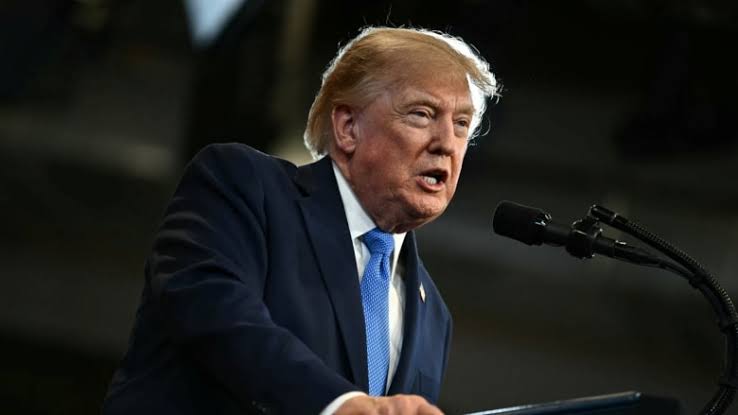
US President Donald Trump has escalated his confrontation with Iran by posting a map on social media labelling the strategically vital Strait of Hormuz “New US Territory.”
The post came days after Trump said he would move to declare the waterway a territory of the United States after what he described as the defeat of Iran.
However, despite the provocative declaration, there is no indication that the Strait of Hormuz has legally become US territory. Trump’s post represents his stated position and an escalation in US rhetoric over control of the waterway, not an internationally recognised transfer of sovereignty.
The development comes amid an escalating confrontation between Washington and Tehran, with the Strait of Hormuz at the centre of the dispute.
Trump doubles down on Hormuz claim
Trump had first raised the possibility of claiming the waterway during a speech on Long Island on Friday.
“After we finish defeating Iran … pretty soon I’ll be declaring the Hormuz Strait a territory of the United States,” Trump said.
He argued that the US already effectively controls the waterway because of its naval blockade.
“Essentially, that’s what it is. We have the blockade. No ships get through unless we want them to,” he said, according to reports of the remarks.
On Monday, Trump went further when asked about the proposal, saying he liked the idea of declaring the Strait of Hormuz a US territory.
On Tuesday, he posted the map carrying the words “New US Territory”, apparently turning his earlier verbal proposal into a more explicit political message.
The move immediately drew attention because the waterway is not under US sovereignty.
What is the Strait of Hormuz?
The Strait of Hormuz is one of the world’s most important maritime chokepoints, connecting the Persian Gulf with the Gulf of Oman and the Arabian Sea.
At its narrowest point, the strait is about 21 nautical miles wide, and its waters lie between Iran and Oman. A significant portion of the world’s seaborne oil trade normally passes through the waterway.
Its strategic importance has made control and freedom of navigation through Hormuz a central issue in the confrontation between Iran and the United States.
Trump has repeatedly asserted that the US now controls the strait through its naval presence and blockade.
On August 12, he said the United States had “total control” of the waterway, describing the American naval blockade as a “WALL OF STEEL.”
The White House has similarly described US forces as having naval control of the strait.
But Trump’s declaration does not change its legal status
The distinction between military control and sovereignty is crucial.
International maritime law does not allow a country to simply convert another region’s territorial waters into its own territory by announcing it.
The United Nations Convention on the Law of the Sea (UNCLOS) provides that the sovereignty of a coastal state extends to its territorial sea, subject to international law. It allows coastal states to establish territorial seas extending up to 12 nautical miles from their baselines.
For international straits, UNCLOS also provides a separate legal regime governing transit passage.
Under Article 34, the fact that a waterway is an international strait does not remove the sovereignty or jurisdiction of the states bordering it. Article 38 establishes a right of transit passage for ships and aircraft through qualifying international straits.
That means the legal framework surrounding Hormuz is more complicated than simply determining which military force currently has the greater presence.
Iran has also formally stated that its sovereignty extends to its territorial sea in the Strait of Hormuz and has specified a 12-nautical-mile territorial sea under its maritime legislation.
Iran rejects Trump’s claim
Iran has rejected Trump’s statements regarding the waterway.
Iranian officials have maintained that the Strait of Hormuz remains subject to Iranian authority and have dismissed the American territorial claim.
The Iranian government has also tied the reopening of the waterway to its demands concerning the US blockade, sanctions, frozen Iranian assets and the broader military confrontation.
Iran’s position has been reinforced by its insistence that the United States cannot simply determine the status of the waterway through military force.
The dispute has therefore moved beyond freedom of navigation and into a much larger confrontation over sovereignty, military power and control of one of the world’s most important energy routes.
US-Iran talks remain stalled
Trump’s latest move comes as diplomatic efforts between Washington and Tehran remain uncertain.
On Tuesday, Trump said there were no talks taking place between the United States and Iran and that none were scheduled.
That statement came despite indications from other officials that back-channel contacts or diplomatic efforts have continued. Reuters reported that Iranian officials have maintained that the strait would remain closed until Washington meets conditions linked to an earlier interim agreement.
The breakdown has also affected energy markets.
Oil prices climbed for a third consecutive session on Tuesday as hopes for a renewed US-Iran agreement faded and concerns about prolonged disruption to oil supplies through Hormuz increased. Brent crude reached about $91.07 a barrel, while US West Texas Intermediate rose to about $84.99.
The economic stakes are therefore enormous.
Any prolonged disruption in Hormuz can affect oil supplies, shipping costs, insurance premiums and fuel prices far beyond the Middle East.
Trump has previously called for greater US control
The latest declaration did not emerge in isolation.
In July, Trump said the United States would become the “guardian” of the Strait of Hormuz and suggested that Washington could collect tolls from ships using the route.
The White House later said Trump had established total naval control over the waterway and described the US blockade as part of its pressure campaign against Iran.
Trump’s rhetoric has consequently evolved from wanting the US to guarantee security and navigation in Hormuz to suggesting that the waterway itself should become American territory.
That is a significant escalation in language.
A strategic waterway at the centre of a wider conflict
For Washington, control of Hormuz is closely connected to the broader campaign against Iran and Trump’s stated objective of preventing Tehran from obtaining a nuclear weapon.
For Iran, control of the waterway remains one of its most powerful strategic tools.
For the international shipping industry, however, the immediate concern is whether commercial vessels can safely navigate the route.
The United Nations has reaffirmed the importance of transit rights through the Strait of Hormuz under international law and called for freedom of navigation to be respected.
That makes the latest Trump declaration particularly consequential.
If Washington were to attempt to turn the statement into an actual territorial claim, it would raise fundamental questions about sovereignty, international maritime law and the rights of Iran and Oman as states bordering the strait.
For now, Trump’s “New US Territory” label remains a political declaration rather than an internationally recognised change in sovereignty.
But with US and Iranian forces still locked in a confrontation, diplomatic talks stalled and global energy markets watching closely, the future of the Strait of Hormuz has become one of the most consequential issues in the widening crisis.