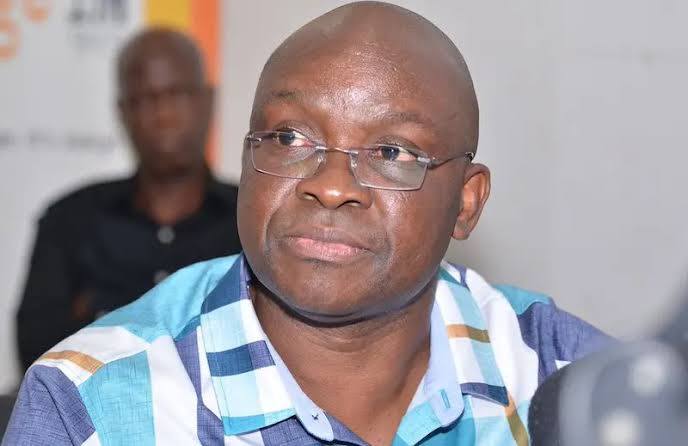
Former Ekiti State Governor Ayodele Fayose has argued that former Vice President Atiku Abubakar is too old to contest the 2027 presidential election, drawing a comparison between the Nigerian politician and former United States President Joe Biden.
Fayose’s latest comments come as Atiku, now a leading figure in the opposition African Democratic Congress (ADC), continues to position himself for another attempt at the Nigerian presidency.
The issue of Atiku’s age has become one of the recurring arguments surrounding his 2027 ambition, with supporters pointing to his experience while critics question whether Nigeria should elect another president approaching 80.
Atiku was born on November 25, 1946, meaning he will be 80 years old when Nigerians vote in the 2027 presidential election.
The former vice president has nevertheless dismissed concerns about his age and has continued to present experience as one of his major advantages.
In an April 2026 interview with Arise Television, Atiku defended the value of experience in leadership, arguing that some younger governors had struggled in office and suggesting that the younger generation could benefit from the guidance of experienced leaders.
Fayose takes the opposite position.
The former governor has repeatedly argued that Nigeria needs a younger generation of political leaders and that older politicians should make room for younger Nigerians.
His criticism of Atiku is not entirely new.
In October 2024, Fayose publicly urged Atiku to abandon his presidential ambition, arguing that the former vice president would be around 80 or 81 by the time of the 2027 election. Fayose said Nigerians were increasingly looking toward younger generations of leaders.
The comparison with Biden adds another dimension to the argument.
Biden, who was 81 when he sought re-election in the United States in 2024, became the subject of intense political debate over his age and ability to continue serving as president. He eventually withdrew from the presidential race before the election.
Fayose’s argument appears to draw on that experience to question whether age should become an important consideration in Nigeria’s 2027 presidential contest.
However, age itself does not legally prevent Atiku from contesting.
Nigeria’s Constitution sets a minimum age of 40 for anyone seeking the presidency; it does not impose a maximum age limit.
Atiku’s supporters have consequently argued that the question should be about competence, capacity and the ability to govern rather than the candidate’s age.
The debate has also become politically significant because Atiku is no longer operating from exactly the same political position he occupied in 2023.
He has moved into the ADC-led opposition coalition and emerged as one of the major figures attempting to challenge President Bola Tinubu and the ruling All Progressives Congress in 2027.
That coalition has brought together several prominent opposition figures and has intensified speculation over who will ultimately secure the presidential ticket.
Atiku’s experience is one of the factors his supporters point to as an advantage.
He previously served as vice president between 1999 and 2007 and has contested the presidency multiple times.
His supporters believe that his experience in government and politics gives him an understanding of Nigeria’s political and economic challenges that younger candidates may not possess.
But critics argue that the country needs generational change.
That argument has become particularly prominent among younger Nigerians, many of whom have expressed frustration with the dominance of politicians who have occupied influential positions for decades.
The 2027 election is therefore likely to turn the age question into a broader debate about experience versus generational change.
Fayose’s position is clear: he believes Atiku should step aside.
But Atiku has shown no indication that age-related criticism will make him abandon his ambition.
With the 2027 campaign now underway, the debate is likely to become even more intense as opposition parties move toward deciding who will lead their challenge to Tinubu.
For now, Fayose’s statement remains a political assessment rather than an electoral verdict.
Whether Nigerian voters agree that Atiku is too old — or instead consider his experience an advantage — will ultimately be decided at the ballot box.