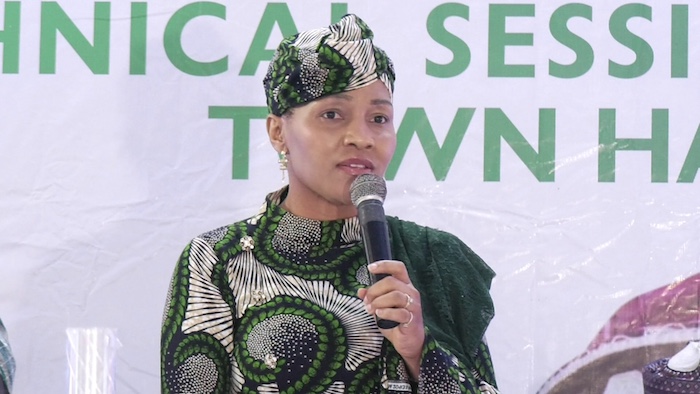
Director-General of the Presidential Enabling Business Environment Council, Princess Zahrah Mustapha Audu, has described President Bola Ahmed Tinubu as “Nigeria’s greatest-ever leader”, arguing that his legacy should ultimately be judged by institution-building and difficult reforms rather than immediate public comfort.
Audu made the assessment while defending the administration’s record and urging Nigerians to examine Tinubu’s leadership beyond the short-term consequences of his economic policies.
Her comments add to the growing political debate over the president’s record as he prepares to seek re-election in 2027.
According to current reporting, Audu argued that Tinubu’s leadership should be assessed through the reforms and institutions being built under his administration, rather than solely through immediate economic conditions.
‘Judge Him by Institution-Building’
Audu’s argument centres on the idea that major national reforms often produce political and economic discomfort before their longer-term effects become visible.
She pointed to Tinubu’s policy direction and described the current period as one of consequential leadership.
The position is consistent with the administration’s broader defence of its economic reforms.
Since taking office in 2023, Tinubu has pursued policies including the removal of the petrol subsidy and changes to the foreign-exchange regime.
The government has argued that these measures were necessary to address longstanding structural weaknesses and place the economy on a more sustainable footing.
Critics, however, have pointed to the significant rise in living costs and pressure on households following the reforms.
A Political Assessment
Audu’s description of Tinubu as Nigeria’s greatest-ever leader is inherently an assessment rather than an objective historical ranking.
Nigeria has had several presidents and military and civilian leaders since independence, each associated with different policies, achievements and controversies.
The debate over Tinubu’s place in that history will therefore depend heavily on how his administration’s policies are ultimately evaluated.
Audu nevertheless believes the president’s legacy should be measured by what she described as structural and institutional changes.
She urged Nigerians to examine the administration’s record seriously rather than dismissing the claim as political rhetoric.
Tinubu’s Political History
Audu also traced Tinubu’s political career over several decades.
She highlighted his time as a senator during Nigeria’s Third Republic, his involvement in the pro-democracy struggle and subsequent exile, and his two terms as governor of Lagos State beginning in 1999.
Tinubu later became one of the central figures in the formation of the APC and eventually won the presidency in 2023.
His supporters frequently point to his political longevity and experience as evidence of his capacity to manage complex political and institutional challenges.
His critics, meanwhile, have questioned aspects of his record in Lagos and the national policies implemented since he became president.
The 2027 Question
The assessment comes at an important moment in Nigerian politics.
Tinubu is seeking another term, while opposition parties are preparing candidates and alliances to challenge him.
The president’s economic record is likely to remain one of the most important issues in the 2027 campaign.
The APC will argue that the administration’s reforms are laying the foundation for stronger economic growth and institutional development.
Opposition candidates are expected to focus heavily on the immediate impact of inflation, energy costs, unemployment and declining household purchasing power.
Audu’s comments therefore form part of a larger political effort to frame Tinubu’s presidency in terms of long-term transformation rather than short-term hardship.
Whether Nigerians ultimately accept that argument will be decided not only by political messaging but also by their assessment of economic conditions, government performance and the direction of the country as the next election approaches.
For now, the PEBEC director-general remains firmly convinced that Tinubu’s historical significance will be measured favourably and that his administration’s reform agenda deserves a more long-term assessment.