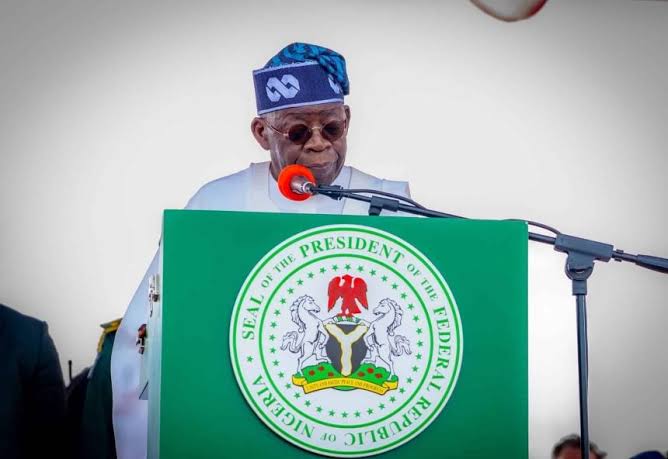
President Bola Ahmed Tinubu has acknowledged that millions of Nigerians continue to struggle with the cost of food, education, healthcare and transportation, saying his administration cannot erase in four years problems that accumulated over generations.
Tinubu made the remarks in his Independence Day address to Nigerians on Thursday, October 1, 2026, as the country marked its 66th anniversary of independence.
“We cannot erase in four years what accumulated over generations. But we can change its course.”
The President said the hardship confronting many households predates his administration and is linked to decades of low productivity, inadequate infrastructure, limited opportunities and institutional weaknesses.
He nevertheless acknowledged the immediate difficulties faced by Nigerians, including families struggling to afford their next meal, school fees, medical bills and transportation.
Tinubu Defends Economic Reforms
Tinubu said his administration deliberately chose to pursue difficult economic reforms rather than continue policies he described as postponing Nigeria’s structural problems.
According to the President, the reforms were intended to correct the direction of the economy and create the foundation for sustainable growth.
He argued that increased productivity, improved infrastructure, lower production costs and a more competitive business environment would eventually translate into lower prices and greater economic opportunities.
The President said the government’s focus is now shifting from reform to translating those changes into broader prosperity.
‘Millions Cannot Wait for Tomorrow’
While defending the longer-term objectives of the reforms, Tinubu acknowledged that vulnerable Nigerians cannot simply wait for future economic gains.
He said the government was strengthening social support mechanisms, including efforts to improve the National Social Register and ensure assistance reaches households considered most vulnerable.
He also highlighted the Nigerian Education Loan Fund, consumer credit initiatives and investments in primary healthcare and basic education as measures intended to provide support while the wider economy expands.
“These programmes are not substitutes for prosperity,” Tinubu said in his address, describing them as a bridge towards broader economic opportunity.
President Promises Poverty Reduction
Tinubu said the ultimate objective of his administration was not merely to manage poverty but to reduce and eventually defeat it through sustained economic growth and the creation of productive opportunities.
He pointed to Nigeria’s young population as a major economic asset and said the government would prioritise jobs, enterprise, industrial development, digital connectivity and skills.
The President also said Nigeria would seek to expand domestic production, support manufacturing and agriculture, and create conditions for Nigerian businesses to compete internationally.
The administration has characterised the reforms as necessary to correct long-standing economic distortions, while critics have continued to focus on the immediate burden of higher living costs on households. The competing assessments underscore the distinction between the government’s stated long-term objectives and the short-term experiences of citizens.
‘The Age of Prosperity’
Tinubu declared that the period of major economic reforms had laid the foundation for what he called an “age of prosperity.”
He said Nigeria had “corrected its course” and urged citizens to look ahead rather than return to previous economic arrangements.
The President acknowledged that achieving the promised transformation would take time and require sustained economic growth and the creation of millions of productive opportunities.
His Independence Day message therefore placed the government’s economic agenda at the centre of Nigeria’s 66th anniversary, combining an acknowledgement of present hardship with a defence of the direction of its reforms.