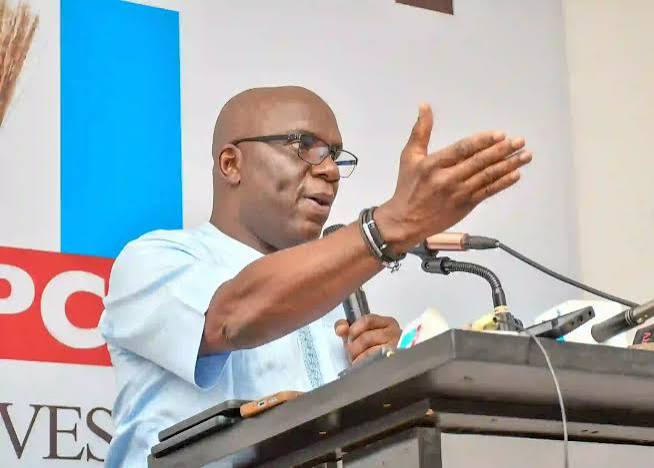
The National Publicity Secretary of the All Progressives Congress (APC), Felix Morka, has defended President Bola Ahmed Tinubu against criticism over Nigeria’s persistent poverty and rising cost of living, arguing that the country’s economic challenges predate the current administration.
Morka made the remarks during an appearance on ARISE News’ Right of Reply programme on Tuesday, where he challenged opposition figures who have criticised Tinubu’s handling of hunger and poverty.
He maintained that poverty had remained a longstanding problem under successive Nigerian governments and could not be attributed exclusively to the administration that assumed office in May 2023.
His comments come amid continuing political debate over the effects of the Federal Government’s economic reforms, particularly the removal of petrol subsidies, exchange-rate changes and the rising cost of essential goods and services.
Morka Says Poverty Predates Tinubu’s Administration
Defending the President, Morka argued that poverty was not unique to Nigeria and had remained a challenge across different societies.
He rejected suggestions that acknowledging previous administrations’ failures amounted to an attempt to avoid responsibility for current economic conditions.
According to the APC spokesman, successive governments had struggled to eliminate poverty despite their different policies and economic programmes.
He specifically referred to former President Olusegun Obasanjo and former Vice-President Atiku Abubakar, noting that they jointly served in government for eight years without eliminating poverty.
Morka argued that the persistence of the problem demonstrated the difficulty of addressing it through political promises alone.
He also maintained that Tinubu had not promised to eradicate poverty within his first 100 days or a specific number of years in office.
The APC spokesman’s position was that addressing poverty required sustained policy implementation rather than expectations that a single administration could resolve the problem immediately.
Opposition Criticism Centres on Current Economic Conditions
The exchange reflects the continuing disagreement between the ruling party and opposition figures over responsibility for Nigeria’s economic difficulties.
Opposition politicians have repeatedly criticised the government over the cost of living, arguing that economic reforms have placed substantial pressure on households.
Food prices, transportation expenses, housing costs and other essential expenditures remain central to public discussions about living standards.
For many households, the immediate question is whether government policies are improving purchasing power and creating sufficient economic opportunities.
The APC, meanwhile, has defended the need for reforms aimed at addressing structural weaknesses in the economy and improving public finances.
The disagreement has increasingly become part of the political contest ahead of the 2027 general election, with both sides seeking to persuade voters that their preferred policies offer a better path towards economic recovery.
Debate Over Responsibility and Results
While Morka’s argument places Nigeria’s poverty challenge in a historical context, the record of previous administrations does not remove the responsibility of the current government to address conditions during its tenure.
Equally, assessing the performance of the current administration requires examining measurable economic indicators and their effects on households rather than relying solely on political statements.
Important considerations include employment levels, real wages, food affordability, inflation, access to essential services and the distribution of economic opportunities.
The government’s reform programme will ultimately be judged partly by whether it produces sustainable improvements in these areas.
The opposition’s criticisms, in turn, raise questions about the alternative policies it would implement and how those proposals would address the country’s fiscal and structural challenges.
As the 2027 election approaches, the debate over poverty is likely to remain central to discussions about economic management, public accountability and the future direction of Nigeria.