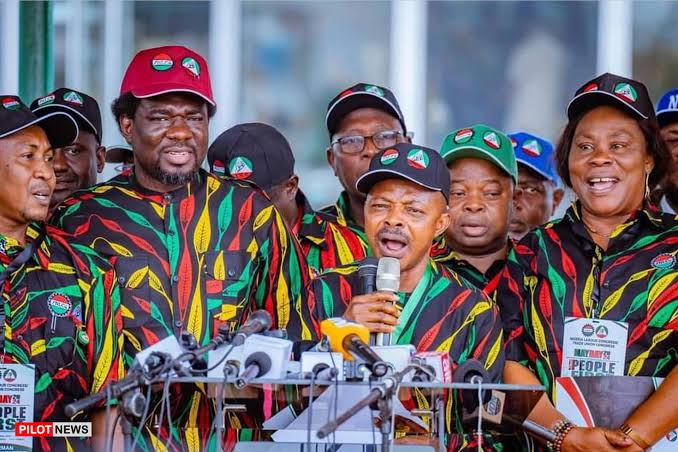
NLC President Joe Ajaero made the demand on Tuesday in Abuja during the presentation of an investigative research report on minimum wage and pension payment compliance in Nigeria, conducted in collaboration with ActionAid Nigeria.
Ajaero argued that the prevailing economic conditions warranted an early review of workers’ earnings, insisting that negotiations should not be postponed until August, as proposed by the Trade Union Congress (TUC).
He maintained that workers were struggling to meet basic household expenses and that the current wage was increasingly inadequate against the cost of food, transportation, housing and other essential services.
Labour Seeks Early Start to Wage Review
The NLC president said discussions on a new minimum wage should begin immediately to prevent delays in reaching an agreement.
He argued that waiting until the final stages of the existing wage cycle could create unnecessary pressure and prolong uncertainty for workers already facing economic hardship.
According to Ajaero, the National Minimum Wage Act of 2024 raised the statutory minimum wage from ₦30,000 to ₦70,000 and reduced the period for reviewing the wage from five years to three years.
The change was intended to provide a shorter review cycle in response to changing economic conditions.
Ajaero said the provisions of the law made it necessary for stakeholders to begin preparations for the next review well ahead of the relevant deadline.
He warned that delaying negotiations could reproduce the difficulties experienced during previous wage discussions, when disagreements between organised labour and government prolonged the process.
Inflation Erodes Workers’ Purchasing Power
The NLC’s demand comes amid persistent concerns about the rising cost of living in Nigeria.
Workers and households have faced pressure from higher food prices, transportation expenses, energy costs and other essential expenditures.
For employees on fixed incomes, these increases can reduce the amount of goods and services their wages can purchase, even when their nominal salaries remain unchanged.
The labour movement has consequently maintained that wage reviews must take account of the wider economic environment rather than focus solely on statutory timelines.
Ajaero’s comments also highlight the importance of examining whether minimum wage increases are being implemented consistently across federal, state and local government establishments.
The research report launched at the Abuja event examined minimum wage and pension payment compliance, bringing attention to the challenges involved in ensuring that workers and retirees receive their legally prescribed entitlements.
Implementation Remains a Key Challenge
Although the national minimum wage establishes a statutory benchmark, implementation across Nigeria’s different levels of government remains an important issue for organised labour.
The capacity of employers to meet wage obligations, the adequacy of workers’ earnings and compliance with existing agreements are likely to feature prominently in any new negotiations.
A fresh review would also require discussions among government representatives, organised labour and other relevant stakeholders over the appropriate wage level and the arrangements needed to implement it.
For workers, the central concern is whether any adjustment would provide meaningful relief from rising living costs.
For governments and employers, the challenge will be balancing wage commitments with available resources while maintaining public services and economic stability.
The NLC’s call signals an effort to move those discussions forward before the existing review cycle reaches its next major milestone.