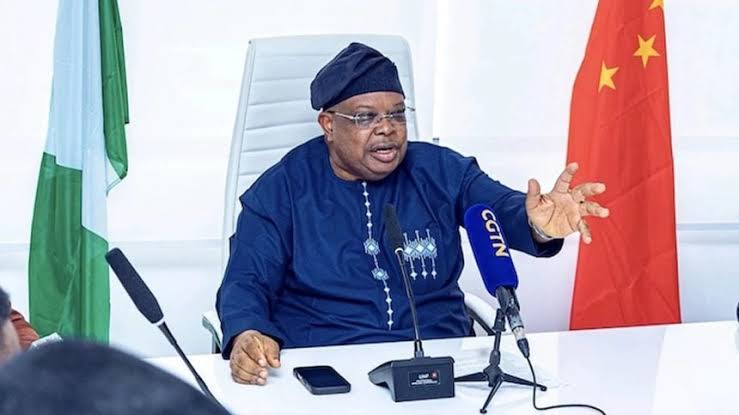
The Lagos–Ogun economic corridor accounts for approximately 50 per cent of Nigeria’s electricity demand, highlighting the importance of targeted investment in power infrastructure, Minister of Power Joseph Tegbe has said.
Tegbe disclosed this at the 13th Nigeria Energy Exhibition and Leadership Summit, where he outlined the Federal Government’s plan to prioritise major economic corridors for electricity infrastructure upgrades.
The government has identified three priority zones: Lagos–Ogun, Enugu–Onitsha–Port Harcourt, and Abuja–Kaduna–Kano.
According to the minister, the strategy is intended to improve electricity supply to industrial and commercial centres, strengthen grid stability and direct investment towards areas where reliable power could deliver substantial economic benefits.
The Lagos–Ogun corridor is particularly important because of its concentration of manufacturing facilities, commercial businesses, data centres and expanding residential communities.
Government Targets High-Demand Economic Zones
Tegbe said the corridor-based approach would allow the government to address critical infrastructure gaps in locations with significant electricity demand before expanding interventions to other areas.
He disclosed that the government was considering additional substations, including facilities equipped with transformers with capacities ranging from 200 megavolt-amperes to 300 megavolt-amperes.
The minister said Lagos–Ogun and the Abuja franchise area would serve as proof-of-concept locations for the wider programme.
He added that the approach would be coordinated with electricity market reforms undertaken by state governments and investment by private-sector operators.
The government’s broader objective is to improve the reliability of supply to businesses and households while ensuring that existing electricity infrastructure is used more effectively.
Three Corridors, Different Economic Priorities
The proposed programme also covers the Enugu–Onitsha–Port Harcourt corridor, which serves industrial, energy and trading centres across the South-East and South-South.
The Abuja–Kaduna–Kano corridor is expected to support manufacturing, agriculture and commercial activity across parts of northern Nigeria.
Tegbe said the selection of the three zones reflected their electricity needs and economic potential.
He also stressed that the federal strategy was not intended to override electricity reforms being implemented by individual states, but to complement those initiatives with coordinated infrastructure investment.
Infrastructure Constraints Remain
Despite the planned interventions, Nigeria’s power sector continues to face challenges involving gas supply to power plants, transmission capacity, pipeline vandalism and losses within the distribution system.
Tegbe said the Federal Government had begun a technical audit of power infrastructure nationwide to assess the condition of existing assets and identify urgent generation and transmission needs.
He also disclosed that outstanding liabilities in the power sector remained a significant concern, with the government working to address liquidity problems and prevent further accumulation of debt.
The minister said the audit findings would help guide investment decisions based on identified infrastructure needs rather than assumptions.
For businesses operating along the Lagos–Ogun corridor, the effectiveness of the proposed programme will ultimately depend on whether the planned upgrades translate into more reliable electricity, fewer disruptions and lower reliance on alternative power sources.
The government’s corridor-based strategy represents an effort to prioritise infrastructure spending in areas with significant economic activity. Its wider impact will depend on implementation, funding and coordination across the power sector.