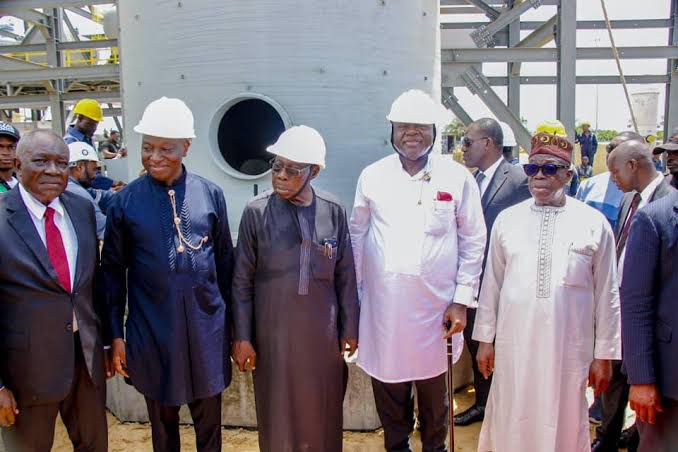
Former President Olusegun Obasanjo has advocated an increase in the 13 per cent derivation allocation to Nigeria’s oil-producing states, arguing that the existing benchmark should be regarded as a starting point for further negotiations.
Obasanjo made the call on Monday at the inauguration of the Crude Distillation Unit (CDU) of the Azikel Refinery in Obunagha, Yenagoa Local Government Area of Bayelsa State.
His remarks have renewed attention to the longstanding debate over revenue allocation, resource ownership and the distribution of oil wealth between the Federal Government and producing communities.
Call for a review of derivation allocation
The 13 per cent derivation principle provides for a share of revenue derived directly from natural resources to be allocated to the states where those resources are produced.
The arrangement is intended to recognise the contribution of resource-producing states to national revenue and address some of the development challenges associated with extraction.
However, questions about the adequacy of the allocation, environmental degradation, infrastructure deficits and the development needs of host communities have remained central to discussions about fiscal federalism.
Obasanjo’s position suggests that the existing percentage need not be treated as permanently fixed, although any change would involve broader fiscal and political considerations.
Azikel Refinery project
The former president also commended the Azikel Group president, Dr Azibapu Eruani, for initiating the refinery project and urged him to ensure its completion within the next 12 months.
The approximately $1 billion project is expected to produce petroleum products, including petrol and diesel, when fully operational. Its stated production targets include 2.5 million litres of petrol and two million litres of diesel daily.
The commissioning of the CDU marks an important stage in the refinery’s development, although the projected production figures should not be interpreted as confirmation that the facility has already reached full commercial output.
Refinery investments are viewed as an important part of efforts to expand domestic processing capacity, reduce reliance on imported petroleum products and strengthen Nigeria’s energy supply chain.
Obasanjo’s intervention brings together two important questions for the oil-producing region: how to secure a fairer share of petroleum revenue and how to translate resource wealth into productive investment, jobs and sustainable development.