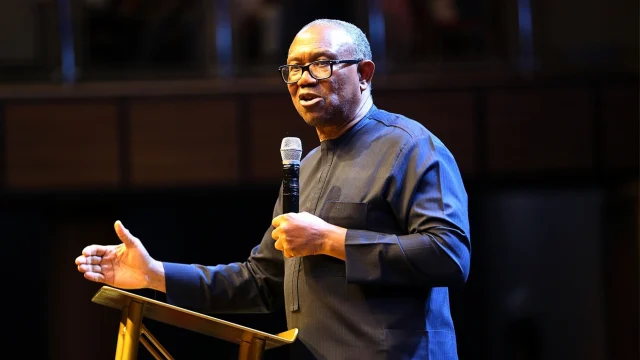
The presidential candidate of the Nigeria Democratic Congress (NDC), Peter Obi, has accused President Bola Tinubu’s administration of gross corruption after citing an International Monetary Fund (IMF) assessment which he said indicated that about ₦8.83 trillion in 2025 public expenditure was not reflected in Nigeria’s budget documents. The Federal Government had not responded to Obi’s statement at the time he made it.
Peter Obi has renewed his criticism of the Tinubu administration, alleging that the Federal Government engaged in off-budget spending amounting to approximately ₦8.83 trillion in 2025 without legislative appropriation.
In a statement posted on his verified X account, Obi described the alleged expenditure as evidence of what he called “gross corruption” and demanded greater accountability in the management of public finances.
According to Obi, the allegations stem from findings contained in the IMF’s latest consultation on Nigeria’s economy.
He claimed that approximately ₦8.83 trillion in government expenditure undertaken in 2025 was not captured in the national budget, meaning the spending was outside legislative oversight and administrative scrutiny.
Obi argued that the amount represents roughly two per cent of Nigeria’s Gross Domestic Product (GDP), exceeds 35 per cent of the country’s 2025 capital budget and is larger than the combined federal allocations to the education and health sectors. He described the situation as evidence of financial mismanagement and renewed his call for accountability.
The IMF recently highlighted discrepancies in Nigeria’s fiscal reporting, noting that public expenditure equivalent to about two per cent of GDP had not been reflected in recent budget documents.
However, the IMF did not describe the omission as corruption. Instead, it recommended that such expenditure be properly reported to improve fiscal transparency and provide a more accurate picture of the country’s public finances.
Obi maintained that the reported expenditure should have been subjected to legislative approval and public scrutiny, arguing that stronger financial accountability is essential for public confidence in government.
At the time Obi issued his statement, the Presidency and the Federal Government had not responded directly to his allegations.
Subsequently, the Federal Government rejected reports that it spent more than ₦8 trillion outside the national budget, insisting that the IMF report had been misinterpreted and that government spending remained within constitutional and legal frameworks. That response is the subject of a separate report.
Obi’s latest comments have intensified debate over public finance management and fiscal transparency as political activities ahead of the 2027 general elections continue to gather momentum. The differing interpretations of the IMF’s findings are expected to remain a major point of contention between the government and opposition figures.