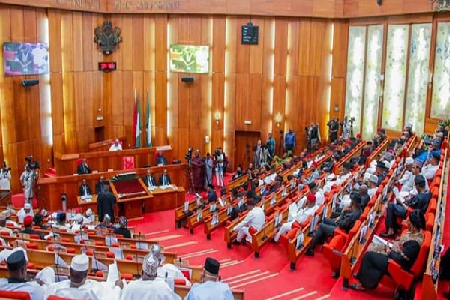
The Nigerian Senate has approved the 2026 budget proposal of the Nigeria Customs Service (NCS), endorsing a revenue target of ₦11.074 trillion and an expenditure estimate of ₦1.295 trillion for the 2026 fiscal year after reviewing the agency’s strong revenue performance in 2025.
The Senate on Wednesday approved the 2026 budget proposal of the Nigeria Customs Service (NCS), giving the green light to a projected revenue target of ₦11.074 trillion alongside a proposed expenditure of ₦1.295 trillion for the 2026 fiscal year.
The approval followed the adoption of the report of the Senate Committee on Customs, Excise and Tariffs during plenary after lawmakers reviewed the Service’s 2025 budget implementation and revenue performance.
Presenting the committee’s report, Chairman of the Senate Committee on Customs, Excise and Tariffs, Senator Isah Jibrin, disclosed that the Nigeria Customs Service exceeded its 2025 revenue target of ₦6.5 trillion, generating approximately ₦7.2 trillion, representing a performance rate of 110.53 per cent.
He, however, noted that the Service could have generated even higher revenue but for factors such as the suspension of excise duty on telecommunications services, government incentives promoting local production of healthcare products and disruptions to global trade arising from the Russia-Ukraine conflict, which affected import volumes, particularly wheat.
On expenditure, the committee reported that although Customs had an approved 2025 budget of about ₦1.132 trillion, actual spending stood at approximately ₦591 billion.
According to Jibrin, delays in project approvals by the Bureau of Public Procurement (BPP) and the Federal Executive Council (FEC) contributed to low capital budget utilisation, leading to the rollover of several projects into the 2026 fiscal year.
The committee explained that the projected ₦11.074 trillion revenue target for 2026 will be driven by expanded deployment of technology, enhanced revenue recovery mechanisms, real-time audit systems, improved trade facilitation and intensified anti-smuggling operations.
Lawmakers also approved the proposed expenditure of ₦1.295 trillion, comprising approximately ₦421 billion for personnel costs, ₦307 billion for overheads and ₦565 billion for capital projects.
The budget is expected to be funded primarily through the statutory four per cent Free on Board (FOB) levy provided under the Nigeria Customs Service Act, 2023.
During deliberations, Deputy Senate President Barau Jibrin commended the Comptroller-General of Customs and the agency’s workforce for surpassing their 2025 revenue target.
He described the Service’s performance as evidence that ongoing reforms within the agency are yielding positive results and expressed confidence that Customs would meet its ambitious 2026 revenue target.
Senate President Godswill Akpabio also praised the committee for its thorough review of the proposal before putting the recommendations to a voice vote, where lawmakers unanimously approved both the revenue target and expenditure estimates.
The Senate’s approval provides the Nigeria Customs Service with one of its most ambitious fiscal targets to date as the agency continues implementing reforms aimed at improving revenue generation, facilitating legitimate trade and strengthening anti-smuggling operations. With expectations now set at more than ₦11 trillion in projected revenue, attention will shift to the Service’s ability to sustain its recent performance and contribute significantly to the Federal Government’s revenue objectives in 2026.