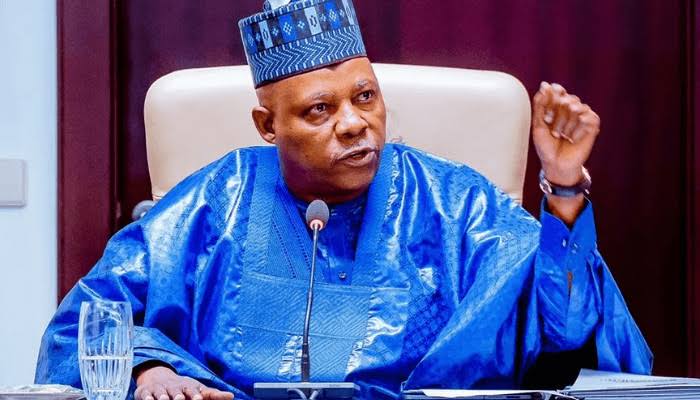
Vice President Kashim Shettima has said Nigeria cannot afford to compromise its energy security, describing reliable electricity as essential to economic growth, public services and national development.
Shettima made the remarks on Wednesday at the groundbreaking ceremony for a new ultramodern National Control Centre of the Nigerian Independent System Operator (NISO) in Osogbo, Osun State.
He was represented at the ceremony by his Senior Special Assistant on Legal Services, Bashir Maidugu.
The project is part of efforts to modernise the infrastructure used to monitor and manage Nigeria’s electricity grid. A report published by Nigerian NewsDirect on September 29 said the new facility was expected to incorporate digital automation and advanced grid-management systems.
Electricity as a Foundation for Development
Shettima said reliable electricity supports industrial production, enables businesses to operate and helps hospitals and schools deliver essential services.
“For Nigeria, therefore, the question of electricity is not merely a question of infrastructure. It is a question of national development,” the Vice President said.
His remarks reflect the Federal Government’s emphasis on electricity supply as a key component of economic performance and public welfare.
For businesses, dependable electricity can reduce reliance on alternative power sources and improve operating conditions. Public institutions also require reliable power to maintain essential services.
Role of the National Control Centre
The National Control Centre plays a central role in monitoring electricity generation and coordinating the operation of the national grid.
A modern control facility can support improved monitoring, system coordination and responses to operational disturbances, depending on the technology installed and how effectively it is used.
The new Osogbo project is intended to strengthen the systems supporting national electricity-grid operations.
However, the benefits of modern control infrastructure will also depend on generation capacity, transmission networks, distribution infrastructure, maintenance and coordination among electricity-sector participants.
Implementation and Grid Reliability
The groundbreaking ceremony marks a step in the development of the facility, but it does not in itself demonstrate that electricity supply has improved.
The project’s eventual contribution will depend on completion, commissioning, integration with existing systems and the operational performance of the infrastructure.
Shettima’s remarks place energy security at the centre of Nigeria’s development priorities, while the new control centre represents an infrastructure investment intended to support electricity-grid management.