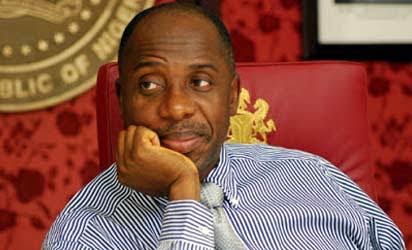
Former Rivers State Governor Rotimi Amaechi has argued that the opposition’s chances of winning substantial support in Northern Nigeria would be weakened without former Vice President Atiku Abubakar as its presidential candidate in the 2027 general election.
Amaechi, the African Democratic Congress (ADC) vice-presidential candidate, made the remarks while discussing the emerging presidential contest and the importance of regional political support.
He argued that Atiku’s background and political base made him particularly important to the opposition’s prospects in the North.
“The opposition will not win in the North because Atiku Abubakar is the only presidential candidate from Northern Nigeria,” Amaechi said.
The statement reflects the ADC ticket’s emphasis on Atiku’s regional appeal as the party seeks to build a nationwide coalition ahead of the election.
ADC emphasises northern political support
Atiku, a former vice president, is the ADC’s presidential candidate, with Amaechi serving as his running mate.
The party is seeking to position itself as a challenger to the ruling All Progressives Congress (APC), whose presidential candidate is incumbent President Bola Ahmed Tinubu.
Amaechi’s argument centres on the electoral significance of regional identity and established political networks in a country where presidential candidates must assemble support across different geopolitical zones.
Northern Nigeria represents a major electoral constituency, making the region an important battleground for parties seeking to win the presidency.
However, a candidate’s regional origin does not automatically guarantee votes across the region. Electoral outcomes also depend on party organisation, campaign performance, local political alliances, policy proposals and voters’ assessments of the candidates.
A contest shaped by national and regional calculations
Amaechi’s remarks come as political parties and their supporters debate the likely strengths and weaknesses of the emerging presidential tickets.
For the ADC, Atiku’s political experience and northern connections could form part of its campaign strategy, while Amaechi’s role may be intended to broaden the ticket’s appeal beyond its presidential candidate’s strongest areas.
The APC, meanwhile, will seek to defend its position through its own political networks and record in office.
The election’s outcome will depend on the ability of the competing parties to mobilise voters across the country, not solely on the regional backgrounds of their candidates.
Amaechi’s assertion that Tinubu and Peter Obi cannot win any northern state should therefore be understood as a political prediction rather than an established fact about the 2027 election.
Voters will determine the outcome
With the election still ahead, parties face the task of translating endorsements, alliances and regional mobilisation into actual votes.
The strength of each campaign will become clearer as candidates present their programmes, party structures expand and voters evaluate the competing offers.
For the ADC, the immediate challenge is to demonstrate that its ticket can attract support beyond its existing political base and offer a convincing national alternative.
Whether Atiku’s candidacy will deliver the northern support Amaechi anticipates remains to be determined at the ballot box.