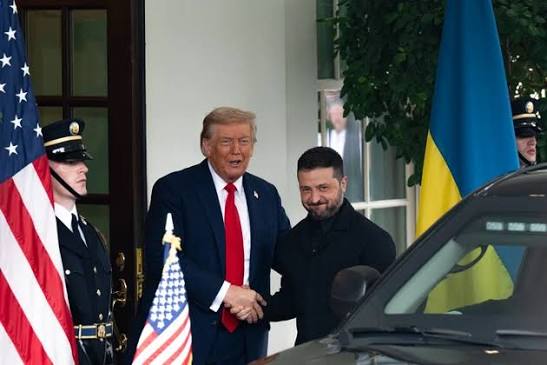
United States President Donald Trump has said Ukraine should consider electing a new president, intensifying his criticism of Ukrainian President Volodymyr Zelenskyy amid disagreements over the war with Russia and Ukraine’s attacks on Russian oil refineries.
Trump made the remarks on Saturday, October 10, 2026, arguing that Zelenskyy’s leadership had failed to bring the conflict to an end and criticising Ukraine’s military operations against Russian energy infrastructure.
The comments came amid renewed tensions between Washington and Kyiv over how to end the war and the impact of the conflict on international energy markets.
Trump has also criticised Ukraine’s attacks on Russian oil facilities, which Kyiv regards as part of its effort to weaken Moscow’s capacity to finance and sustain its military campaign.
Trump questions Zelenskyy’s leadership
Trump’s remarks represent a further escalation in his public criticism of the Ukrainian president, whose government has sought continued Western military, financial and diplomatic support since Russia launched its full-scale invasion in February 2022.
The US president has repeatedly emphasised the need for a negotiated settlement, while Ukraine has maintained that any agreement must protect its sovereignty and security.
The latest comments come as the Trump administration faces competing demands: reducing the economic consequences of the war, pursuing negotiations with Moscow and maintaining relations with Kyiv and European allies.
Trump’s criticism of Zelenskyy has also raised questions about the future direction of US policy towards Ukraine and the conditions under which Washington will continue supporting the country.
Dispute over attacks on Russian oil refineries
Ukraine has targeted Russian oil refineries and other energy-related facilities as part of its campaign to disrupt infrastructure that contributes to Russia’s war effort.
Such attacks can affect fuel production, logistics and revenue, although their overall strategic impact depends on the extent of the damage and Russia’s ability to repair facilities or redirect supplies.
Trump has criticised the operations, linking them to energy-market pressures and arguing that Ukraine’s approach has complicated efforts to reach a settlement.
The disagreement has unfolded alongside wider discussions about Russian diesel supplies and US measures affecting energy trade. The developments have raised concerns in Kyiv and among European partners about whether changes in Washington’s policy could ease economic pressure on Moscow.
Ukraine’s position and the prospects for negotiations
Zelenskyy’s government has continued to argue that Ukraine must be able to defend itself against Russian attacks and secure meaningful guarantees against future aggression.
The dispute reflects a broader challenge in efforts to end the war: the United States, Ukraine, Russia and European governments do not necessarily share the same assessment of the concessions required for a settlement.
Trump’s latest comments have added pressure to an already difficult diplomatic relationship, although a public demand for a change in Ukraine’s leadership does not itself determine the country’s political future.
Ukraine’s presidency and electoral process are matters for the country’s constitutional and legal framework. Any change in leadership would depend on Ukraine’s own political processes rather than a declaration by a foreign head of state.
The key questions now concern whether Washington and Kyiv can reconcile their differences over military strategy, energy infrastructure and the terms of a potential peace agreement.