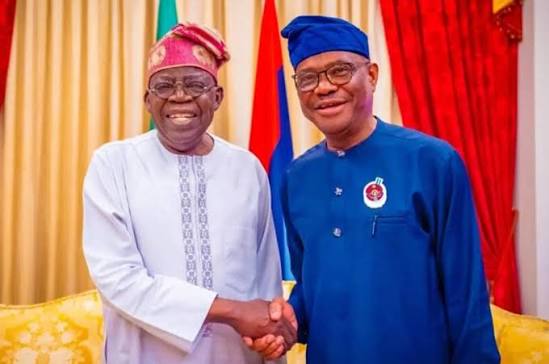
The emerging political alliance being championed by Federal Capital Territory Minister Nyesom Wike in support of President Bola Ahmed Tinubu’s 2027 re-election bid is generating fresh concerns within sections of the All Progressives Congress.
The proposed “Rainbow Coalition” brings together politicians from different parties and political backgrounds, with Wike presenting the alliance as part of a broader effort to support Tinubu’s return to office.
Wike has repeatedly argued that politicians should be judged by their commitment to Nigeria rather than rigid party boundaries.
The former Rivers State governor has also openly positioned himself as a supporter of Tinubu’s 2027 ambition despite remaining a member of the Peoples Democratic Party.
That position has created an unusual political arrangement in which a serving minister from the opposition PDP is helping mobilise support for the incumbent APC president.
Wike’s coalition strategy has already attracted political figures from outside the APC.
Recent reporting indicates that Osun State Governor Ademola Adeleke has been mentioned as part of the emerging alliance, although the political implications of such alignments remain fluid.
The development has raised questions among some APC stakeholders who believe the ruling party should retain a dominant role in its own presidential campaign.
Supporters of Wike’s approach, however, argue that a broad coalition could strengthen Tinubu’s national reach by bringing politicians from different parties and regions into the president’s support base.
The disagreement reflects a wider question confronting the APC as it prepares for 2027: whether the party should rely primarily on its existing structure or expand the Tinubu campaign through a wider cross-party alliance.
Wike has defended the broader strategy, suggesting that political alliances are necessary to win elections and that politicians should be prepared to work across traditional party lines.
His strategy is also influenced by his political history.
After losing the PDP presidential nomination in 2022, Wike became one of the G5 governors who opposed the party’s presidential candidate, Atiku Abubakar, over the party’s internal leadership arrangements.
Following Tinubu’s victory in 2023, Wike was appointed FCT minister despite remaining a member of the PDP.
The arrangement has made him one of the most influential opposition-party figures within the federal government.
For the APC, the attraction of the Rainbow Coalition is clear: an alliance involving politicians from multiple parties could broaden Tinubu’s electoral base.
But it also carries political risks.
Some party members may question whether external political actors are gaining too much influence over the ruling party’s electoral strategy, while others may see the coalition as a practical way to secure support beyond traditional APC constituencies.
With the 2027 election approaching, the coalition is likely to remain a major subject of political debate.
Whether it becomes a formal national alliance or remains a loose network of politicians supporting Tinubu will ultimately depend on negotiations among the participating political actors.
For now, Wike’s strategy has already changed the political conversation around Tinubu’s re-election campaign, demonstrating that the battle for 2027 will extend well beyond conventional party boundaries.