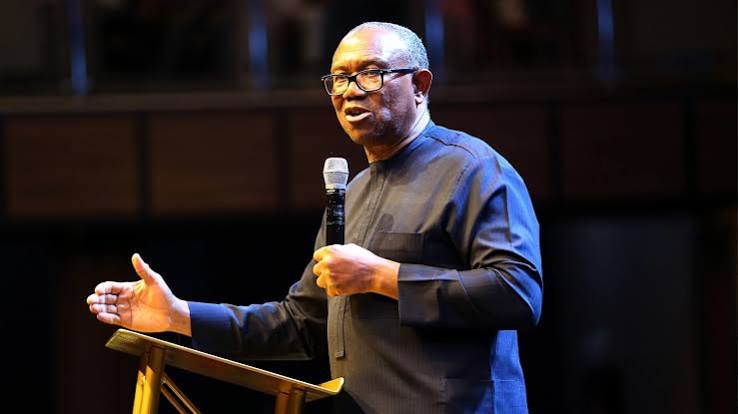
The claim by Peter Obi that he won Nigeria’s 2023 presidential election has renewed political debate ahead of the 2027 general elections, with the ruling All Progressives Congress (APC) pointing to the official results and the outcome of the legal challenges that followed the poll.
Obi, who contested the 2023 election as the presidential candidate of the Labour Party and is now associated with the Nigeria Democratic Congress (NDC), reiterated his position during an interview with the BBC earlier this month.
The former Anambra State governor maintained that he believed he had won the election, despite the official results placing him third behind President Bola Ahmed Tinubu and former Vice-President Atiku Abubakar.
According to the results announced by the Independent National Electoral Commission (INEC), Tinubu secured 8,794,726 votes, Atiku received 6,984,520 votes, while Obi polled 6,101,533 votes.
Tinubu was declared the winner and subsequently sworn in as president in May 2023.
Obi and Atiku challenged the result in court, alleging irregularities and other grounds for overturning the outcome. Their petitions were dismissed by the Presidential Election Petition Court, and the Supreme Court subsequently upheld Tinubu’s victory in October 2023.
During the recent interview, Obi was asked whether he still maintained that he had won the election. He said he stood by his earlier position but acknowledged that he did not have evidence to substantiate the claim when pressed on the matter.
His comments have provided fresh material for political debate as parties prepare for the next presidential election.
For the APC, the official results and court judgments remain central to its defence of Tinubu’s electoral victory. Opposition supporters, meanwhile, continue to question aspects of the 2023 election and the broader electoral process.
However, a candidate’s personal conviction about an election result is distinct from the officially declared outcome and the findings of the courts. The established result of the 2023 presidential election remains Tinubu’s victory.
The renewed exchange also underscores the importance of credible electoral institutions, transparent result-management processes and the availability of verifiable evidence when candidates make claims about election outcomes.
As preparations for 2027 gather momentum, political parties are expected to revisit the previous election while attempting to persuade voters that they can offer better leadership and governance.
For Nigerians, the central issue will be whether the next election can strengthen public confidence in the electoral process and provide a peaceful, credible opportunity for voters to determine the country’s leadership.