President Bola Ahmed Tinubu is set to take his re-election message directly to Nigerians as political activities for the 2027 presidential election enter a new phase.
The Presidency has said the President is prepared to campaign on the record of his administration and the next phase of what it describes as the Renewed Hope Agenda.
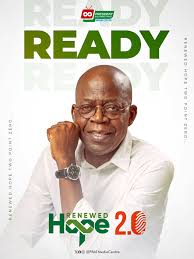
The emerging campaign message is being framed around “Renewed Hope 2.0”, with the administration expected to argue that the difficult economic reforms implemented during Tinubu’s first term require more time to deliver their intended long-term benefits.
Tinubu’s administration has made fuel subsidy removal, foreign-exchange reforms, tax reform, infrastructure investment and increased government revenue central components of its economic programme.
The reforms have, however, also generated considerable public hardship, with Nigerians facing higher transportation, food and household costs.
The 2027 campaign is therefore expected to become a major contest over whether the reforms have produced sufficient results to justify another four years.
Tinubu became the APC’s presidential candidate for the 2027 election after the ruling party’s internal process effectively cleared the way for his candidacy.
Supporters of the President have argued that his administration’s economic reforms have laid the foundation for stronger growth, industrialisation and fiscal stability.
The administration’s second-term pitch is increasingly being presented as a continuation rather than a reversal of the first-term reform programme.
The phrase “Renewed Hope 2.0” has already become associated with the argument that the country needs continuity to consolidate the reforms.
An assessment of Tinubu’s administration published in May argued that the President’s second-term case rests largely on converting macroeconomic reforms into tangible improvements in household welfare, food security, jobs, electricity and security.
The opposition is expected to challenge that narrative by focusing on the cost of living, insecurity, unemployment and the impact of the government’s economic policies on ordinary Nigerians.
With the campaign season beginning in earnest, those competing narratives are likely to dominate Nigeria’s political conversation over the coming months.