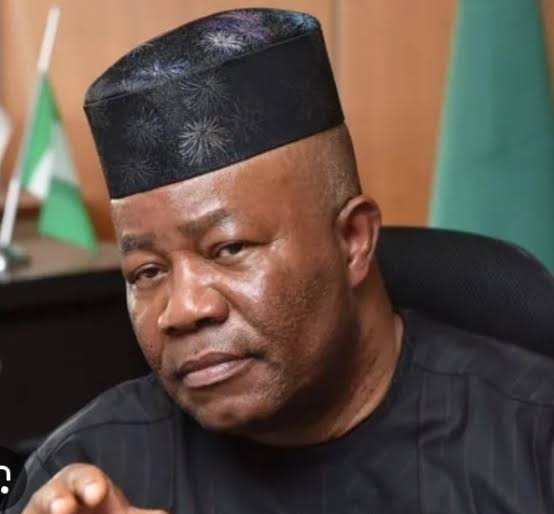
Senate President Godswill Akpabio has defended the working relationship between the National Assembly and President Bola Ahmed Tinubu, insisting that cooperation between both arms of government should not be mistaken for legislative weakness. He said Parliament exists to protect Nigeria’s interests—not to create unnecessary political battles to prove its independence.
Amid growing criticism that the 10th National Assembly has become too accommodating of the Executive, Senate President Godswill Akpabio has pushed back strongly, declaring that lawmakers will not manufacture conflict with President Bola Tinubu simply to convince Nigerians that they are independent.
Speaking during the opening of the 2026 National Assembly Open Week in Abuja, Akpabio argued that democracy is strengthened not by constant confrontation between institutions but by responsible oversight, constructive engagement and policies that serve the public interest.
Addressing lawmakers, diplomats, civil society groups and members of the public, Akpabio acknowledged the growing public perception that the National Assembly has not been sufficiently critical of the Executive.
He rejected that narrative, stressing that working with the Presidency on policies that benefit Nigerians should never be interpreted as abandoning the legislature’s constitutional responsibility.
According to him, Parliament must support initiatives that advance national development, scrutinise proposals that require improvement and reject measures that fail to meet constitutional or public interest standards.
Without directly naming opposition parties or critics, Akpabio said some Nigerians wrongly equate constant disagreement with effective democracy.
He maintained that legislative independence is measured by the quality of oversight, lawmaking and representation—not by creating unnecessary political crises.
“Constructive partnership should never be mistaken for constitutional surrender. Parliament does not prove its independence by manufacturing conflict, nor its relevance by opposing for opposition’s sake,” the Senate President said.
Akpabio also used the event to encourage greater public participation in the legislative process.
He urged Nigerians to attend public hearings, examine bills before lawmakers, engage elected representatives and hold Parliament accountable through informed civic participation.
According to him, democratic institutions become stronger when citizens actively participate rather than observe from a distance.
The Senate President highlighted what he described as key achievements of the current National Assembly, saying lawmakers have passed more than 100 bills within their first three years.
He cited legislation on national security, tax reforms, education, regional development commissions, investment and the new national minimum wage as evidence that Parliament has remained focused on governance rather than political drama.
Akpabio’s remarks come at a time when debate over the independence of the National Assembly has intensified ahead of the 2027 elections. While critics continue to demand stronger oversight of the Executive, the Senate President insists that history will judge Parliament by the quality of its decisions—not by the number of public disagreements it has with the Presidency.