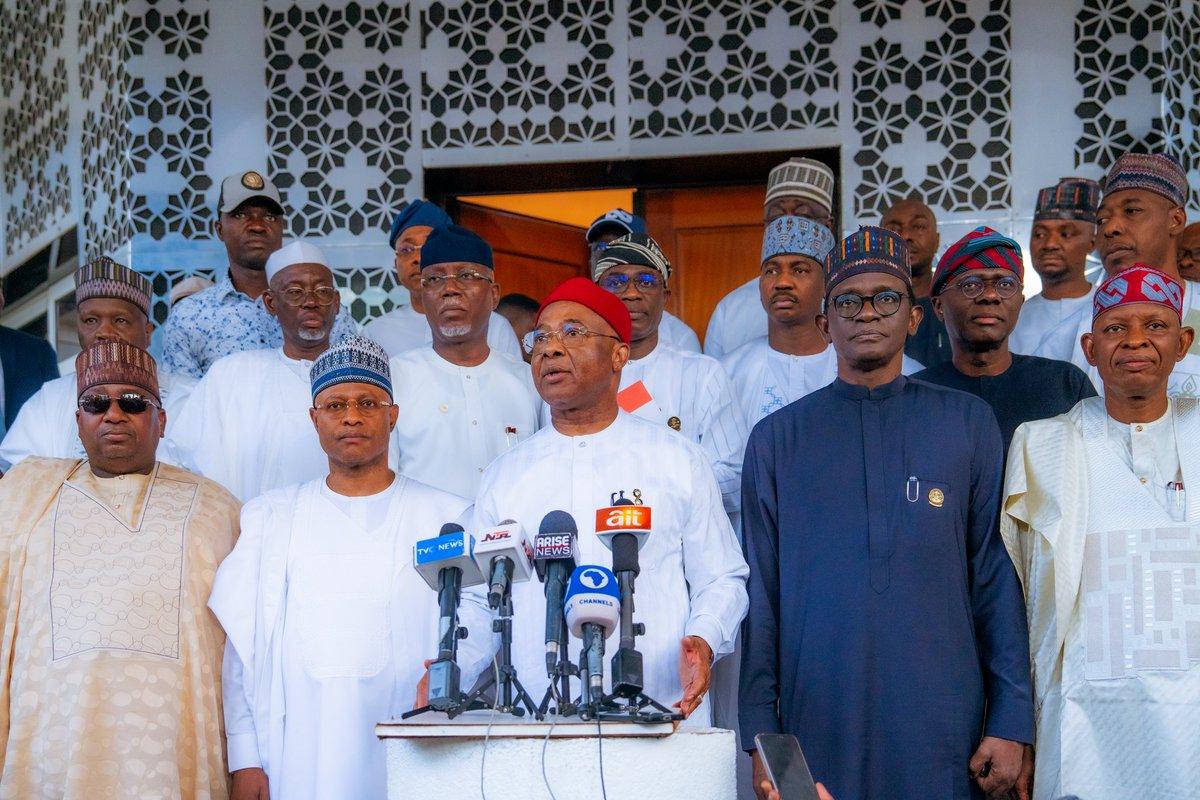
The All Progressives Congress (APC) Governors’ Forum has opposed political alliances that it considers capable of undermining President Bola Ahmed Tinubu’s re-election bid or weakening the party ahead of the 2027 general elections, placing the proposed Rainbow Coalition associated with Federal Capital Territory Minister Nyesom Wike under renewed political scrutiny.
The governors’ position was reported in September 2026, amid discussions over how political support for Tinubu should be organised and whether alliances outside the APC could operate alongside an individual’s declared support for the President.
The dispute raises questions about party membership, coalition-building and the relationship between the ruling party’s formal structures and politicians who support the President without necessarily belonging to the APC.
APC Governors Outline Their Position
The APC Governors’ Forum said its members would not participate in, support or endorse an alliance or political arrangement capable of undermining Tinubu’s re-election bid, weakening the party or adversely affecting its candidates.
The position reflects the governors’ stated concern that political arrangements operating outside the APC could create competing structures or complicate the party’s campaign strategy.
The Rainbow Coalition associated with Wike has become part of this debate because the minister has publicly supported Tinubu’s prospective second-term bid while maintaining political relationships that do not fit neatly within a conventional APC membership structure.
Some APC figures have consequently urged Wike to clarify his political position and formally join the ruling party if he intends to work within its campaign framework.
However, opposition to the coalition should not automatically be interpreted as a unanimous position held by every APC member or political stakeholder. The documented statement concerns the position attributed to the Governors’ Forum.
Wike’s Political Position and Coalition Structure
Wike, a former governor of Rivers State and a prominent figure in the Peoples Democratic Party before his appointment as FCT minister, has continued to occupy a politically significant position despite tensions surrounding party affiliation and alliances.
His support for Tinubu has prompted debate about whether politicians can back a presidential candidate while maintaining separate political platforms or relationships.
For supporters of formal party discipline, the issue concerns consistency between declared allegiance and organisational membership. For those advocating broader political cooperation, alliances may provide a mechanism for building support across party lines.
These competing approaches are part of the wider political negotiations preceding the 2027 election.
The immediate dispute is therefore about more than a coalition’s name: it concerns who controls campaign structures, how supporters are coordinated and whether a presidential campaign should be led exclusively through the ruling party’s established machinery.
Implications for the 2027 Election
The APC’s position could influence discussions about campaign coordination, political defections and cooperation among politicians who support Tinubu.
It also illustrates the difficulty of maintaining party cohesion while accommodating influential political figures whose relationships extend beyond formal party structures.
The eventual direction of the dispute will depend on decisions by the relevant political actors, including whether Wike clarifies his relationship with the APC and how the coalition develops.
For now, the disagreement demonstrates that support for a presidential candidate and membership of the party seeking to return that candidate to office remain distinct questions in Nigeria’s evolving political landscape.