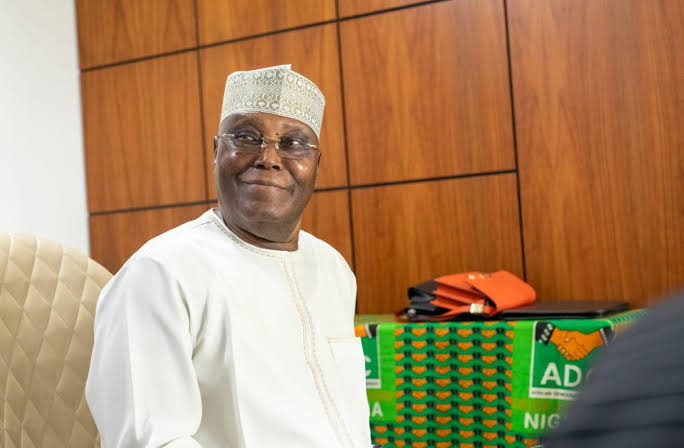
The African Democratic Congress Presidential Campaign Council (ADC-PCC) has described former Vice-President Atiku Abubakar as a pan-Nigerian leader capable of uniting the country, expressing confidence in his prospects ahead of the 2027 presidential election.
The council’s Director of Media and Publicity, Kola Ologbondiyan, made the remarks in Abuja while receiving the leadership of the Grassroots Mobilisation Network (GMN), led by its National Coordinator, Engineer Sadiq Abubakar Adamu Lwafu.
The meeting provided an opportunity for the campaign council to engage with the organisation’s leadership as it outlined its plans to mobilise support for Atiku’s presidential ambition.
Lwafu said the network was embarking on a nationwide mobilisation campaign to promote Atiku’s candidacy, citing economic hardship and insecurity as major concerns facing Nigerians.
He described the ADC as a credible political platform and expressed confidence that the party could challenge the ruling All Progressives Congress (APC) in the forthcoming election.
Responding, Ologbondiyan commended the organisation for its commitment to grassroots mobilisation and welcomed its decision to support the former vice-president.
The campaign spokesman argued that Atiku’s political relationships and experience across different parts of the country positioned him as a candidate capable of appealing to Nigerians beyond ethnic, religious and regional boundaries.
He maintained that the country needed leadership capable of addressing its economic difficulties, improving security and restoring public confidence in government.
ADC Seeks to Expand Its Grassroots Support
The engagement comes as political parties and presidential campaign organisations intensify efforts to build support ahead of the 2027 general election.
For the ADC, grassroots mobilisation is likely to be a critical component of its strategy, particularly as opposition figures seek to challenge the APC’s political structures and strengthen their presence across the federation.
Organisations such as the GMN can potentially assist campaigns by engaging communities, coordinating supporters and communicating candidates’ policies to voters.
However, the effectiveness of such mobilisation will depend on whether campaign organisations can translate public engagements and endorsements into sustained political participation and votes.
Economic Hardship and Insecurity Feature in Campaign Debate
The GMN’s endorsement also highlights the importance of economic conditions and security in the political debate ahead of 2027.
Rising living costs, employment concerns, insecurity and access to public services remain significant issues for many Nigerians. These challenges are likely to shape voters’ assessments of the incumbent administration and the alternatives offered by opposition candidates.
Atiku’s campaign will therefore face the task of presenting clear and credible policy proposals while convincing voters that his experience and political coalition can deliver measurable improvements.
Although the ADC campaign council has expressed confidence in his ability to unite the country, the claim that Atiku deserves victory reflects the campaign’s political position rather than an established electoral outcome.
The extent of his national appeal will ultimately depend on the strength of his campaign, the policies he presents and the willingness of voters across Nigeria’s diverse constituencies to support his candidacy.
As the election approaches, the ADC’s efforts to attract grassroots organisations will form part of the broader contest to build a viable opposition coalition capable of challenging the ruling party.