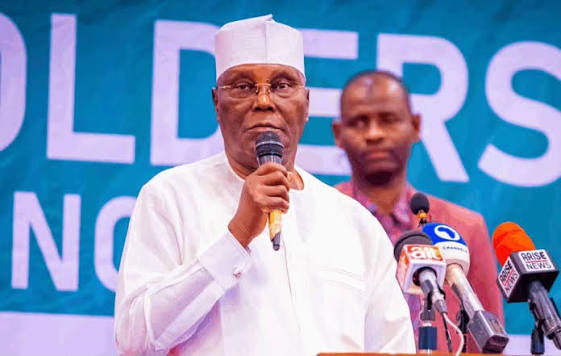
ADC Candidate Wants Experts to Trace Funds Reportedly Paid to 3.29 Million Households
Former Vice President and African Democratic Congress (ADC) presidential candidate, Atiku Abubakar, has pledged to establish an independent team of experts to examine the disbursement of N33.75 billion reportedly paid to 3.29 million vulnerable Nigerian households.
Atiku’s proposed review follows findings by the Office of the Auditor-General for the Federation (OAuGF), which said there was insufficient evidence to independently verify that the funds reached genuine beneficiaries.
Audit Raises Questions Over Cash Transfers
The audit findings relate to electronic transfers made under the Federal Government’s social intervention programme.
According to the audit report, N33.75 billion was reportedly transferred to 3,295,207 households and beneficiaries across 35 states.
The auditors said they were unable to adequately establish the identities of those who received the funds because important records required for reconciliation and verification were not provided.
The audit concerns payments made in 2023, while the relevant report was transmitted to the National Assembly in July 2026.
Atiku Announces Independent Review
Reacting to the findings through his Senior Special Assistant on Public Communication, Phrank Shaibu, Atiku said the issue raises important questions about accountability and the effectiveness of government intervention programmes.
He said his proposed team would include specialists in finance, auditing, technology and public accounting.
The team, according to Atiku, would examine beneficiary records, payment channels, reconciliation documents and audit queries.
Atiku said the objective would be to trace the funds as far as available public and institutional records permit.
How Much Was Each Household Supposedly Receiving?
Based on the figures cited in the audit discussion, N33.75 billion divided among 3.29 million households amounts to approximately N10,258 per household.
Atiku argued that Nigerians deserve clarity over how the intervention was disbursed and whether the intended beneficiaries actually received the funds.
The figure is an arithmetic average and should not automatically be interpreted as proof that every household received exactly N10,258.
Fresh Calls for Investigation
The controversy has already attracted calls for further investigation.
Human rights lawyer and Senior Advocate of Nigeria, Femi Falana, has urged the Economic and Financial Crimes Commission (EFCC) to investigate the matter and recover funds if wrongdoing is established.
The development is therefore moving beyond a political argument into a wider debate about public financial management, audit compliance and accountability for social intervention spending.
What the Audit Does — and Does Not — Establish
The audit findings raise questions over documentation and verification of the payments.
They do not, by themselves, establish that the entire N33.75 billion was stolen or diverted.
Further investigation would be required to determine whether the funds reached legitimate beneficiaries and whether any public official or contractor committed an offence.