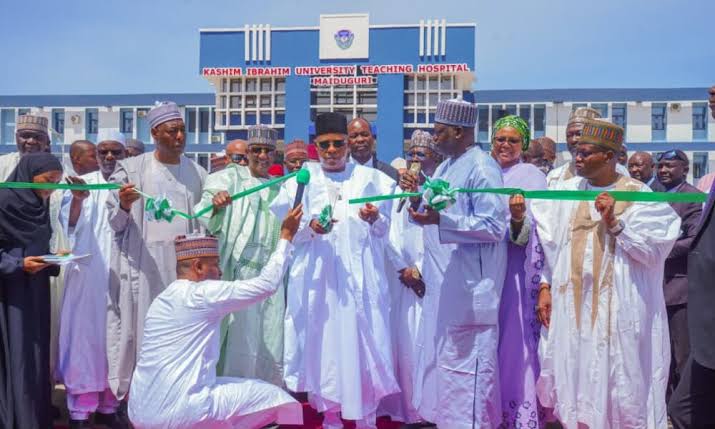
Borno State has inaugurated a 400-bed teaching hospital in Maiduguri as part of efforts to expand access to specialist healthcare, strengthen medical education and reduce the need for residents to travel outside the state for advanced medical treatment.
Vice-President Kashim Shettima commissioned the Kashim Ibrahim University Teaching Hospital on Friday, October 23, alongside other projects delivered by the administration of Governor Babagana Umara Zulum.
The new facility is expected to strengthen healthcare delivery in Borno and neighbouring communities by bringing a wider range of specialist medical services closer to residents, while providing a platform for the training of doctors and other healthcare professionals.
The hospital comprises 13 specialist departments covering diagnostic services, surgery, emergency care, paediatrics, internal medicine and physiotherapy, among other areas.
Its establishment represents a major investment in healthcare infrastructure in a state that has faced years of disruption from insurgency, population displacement and pressure on public services.
The facility is also expected to contribute to efforts to address shortages of trained medical personnel in Borno and the wider North-East region by supporting clinical training and professional development.
Speaking at the commissioning, Shettima commended the state government for investing in healthcare and education, describing the projects as important contributions to the state’s long-term recovery and development.
The vice-president said investments in durable public institutions would have lasting benefits for communities, particularly in areas where insecurity has disrupted access to essential services.
Governor Zulum has repeatedly identified healthcare as a priority of his administration, with investments aimed at improving medical infrastructure and making quality treatment more accessible to residents.
The teaching hospital is equipped with advanced diagnostic technology, including a 1.5-tesla magnetic resonance imaging (MRI) scanner, a 160-slice computed tomography (CT) scanner, conventional and mobile X-ray machines, ultrasound systems, fluoroscopy equipment and a digital mammography machine.
Such facilities are expected to improve diagnostic capacity and support the treatment of conditions that may previously have required patients to seek specialist services outside the state.
Beyond patient care, the institution is designed to support medical education and clinical research, helping to prepare a new generation of healthcare professionals for service in Borno and other parts of Nigeria.
The commissioning also comes amid broader efforts by the state government to rebuild public infrastructure and improve access to essential services following years of conflict involving insurgent groups.
However, the hospital’s long-term impact will depend on the availability of qualified personnel, reliable equipment maintenance, adequate funding and affordable services for patients.
Ensuring that the facility operates consistently at its intended capacity will be critical to reducing medical travel and improving health outcomes across the state.