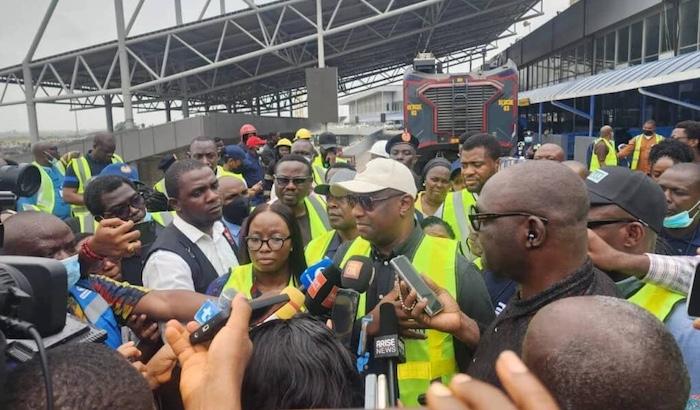
The Federal Government has positioned the N712 billion reconstruction and expansion of Terminal 1 at the Murtala Muhammed International Airport (MMIA), Lagos, as a major infrastructure intervention aimed at transforming Nigeria’s principal international gateway.
Minister of Aviation and Aerospace Development Festus Keyamo disclosed the government’s position on Tuesday at the opening of the 35th Airports Council International (ACI) Africa Annual General Assembly, Board and Committee Meetings, Regional Conference and Exhibition in Abuja.
Keyamo said the intervention forms part of a wider programme to modernise Nigeria’s airport infrastructure and bring the country’s aviation facilities closer to the requirements of next-generation airports.
Government Outlines Vision for Airport Modernisation
The minister described the Terminal 1 project as more than a physical construction exercise, linking airport development to passenger experience, operational efficiency, technology and economic activity.
He said a modern airport should function as an economic ecosystem capable of supporting trade, tourism, logistics, investment and international connectivity.
According to the minister, the quality of airport infrastructure also influences the first impression visitors receive when entering a country.
The government’s stated objective is therefore to develop an airport that communicates efficiency, safety, hospitality and confidence while improving the experience of passengers and other airport users.
Project Scope and Infrastructure Requirements
The reconstruction project involves major rehabilitation and expansion work at the Lagos international airport.
Reporting by Posh Reporters indicates that the project includes Terminal 1 rehabilitation, Terminal 2 expansion, roads, aprons and bridges as part of a broader aviation upgrade programme. It also reports that construction began in March 2026 and is expected to span 22 months, subject to delays.
The project is expected to involve improvements to essential terminal systems and passenger-processing infrastructure.
The broader reconstruction programme highlights the importance of integrating building works with security, baggage handling, passenger movement, accessibility and airport operations.
Beyond Terminals: Building an Aviation Economy
Keyamo also linked the government’s airport-development agenda to the expansion of other parts of Nigeria’s aviation value chain.
The minister identified digital transformation, data-driven decision-making, aircraft maintenance, repair and overhaul (MRO), cargo infrastructure and aircraft leasing as areas relevant to the sector’s long-term development.
These areas are important because airport infrastructure alone does not determine the strength of an aviation industry.
The ability to maintain aircraft locally, expand cargo operations, improve connectivity and attract investment also influences the sector’s economic contribution.
Keyamo said stronger air links across Africa would support the objectives of the Single African Air Transport Market (SAATM) and the African Continental Free Trade Area (AfCFTA).
Project Delivery and Passenger Experience
The reconstruction’s eventual impact will depend on implementation, construction quality, operational continuity and the delivery of promised facilities.
Airport development also requires effective coordination between government agencies, airport operators, airlines, regulators and private-sector stakeholders.
The government’s stated ambition is to use the MMIA project as part of a broader effort to strengthen Nigeria’s international aviation infrastructure.
The quality of the completed project, rather than the scale of the announcement alone, will determine its long-term effect on passengers, airlines and the national economy.