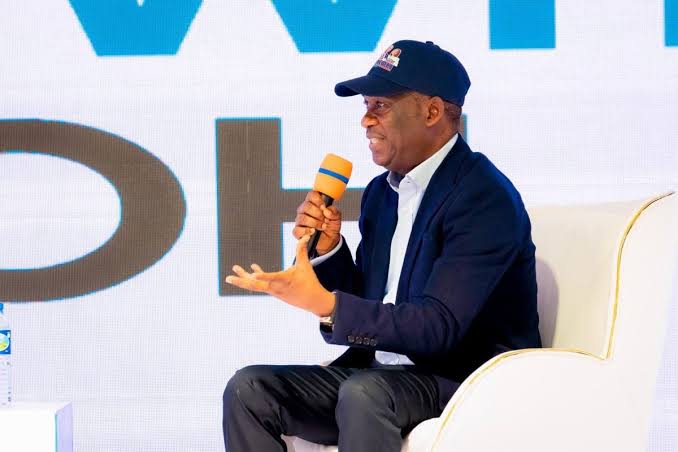
Lagos State Deputy Governor Obafemi Hamzat has defended his description of the city’s notorious traffic congestion as a “lifestyle”, saying the comment was made in the context of how traffic, crowds and the pace of life have shaped Lagos’ creative culture.
Hamzat made the original remarks at Podfest Naija, where he discussed Lagos’ creative industry and the city’s distinctive urban character.
He said commuters stuck in traffic often consume podcasts, music, films and other digital content, making traffic an unexpected source of audience engagement for creators.
Comment Sparks Public Reaction
The remark generated criticism after portions of his comments circulated on social media.
Some reactions interpreted the description as an acceptance of persistent traffic congestion as an ordinary or desirable feature of life in Lagos.
Hamzat subsequently sought to explain the context, saying his intention was not to endorse traffic gridlock or suggest that residents should simply accept the difficulties associated with it.
His comments were instead linked to a discussion about how Lagos’ unique urban environment has influenced the city’s creative economy.
Traffic and the Creative Economy
Hamzat argued that long journeys through major Lagos corridors have created an environment in which people consume media while travelling.
He specifically referenced routes such as Ojota to Obalende and the Third Mainland Bridge, where commuters can spend significant periods in traffic.
According to the deputy governor, those hours have inadvertently provided an audience for podcasters, filmmakers, musicians and other creators.
He described traffic as an “unlikely patron” of the creative industry because commuters use the time to consume digital content.
The broader argument was that Lagos’ challenges and distinctive character have become part of the stories produced by its creative community.
Beyond the Traffic Debate
Hamzat also used the event to discuss the sustainability of Lagos’ creative economy.
He argued that large audiences alone do not guarantee financial sustainability and urged creators to develop business models capable of converting audiences into revenue.
He cited the importance of investment in ideas, research and innovation, while stressing that safety and personal liberty were also important to the development of a creative ecosystem.
The comments place the traffic controversy within a broader conversation about Lagos’ rapidly expanding creative sector.
A Persistent Urban Challenge
Traffic congestion remains a major transportation issue for Lagos, a megacity with a large commuting population and extensive daily movement between residential, commercial and industrial areas.
The deputy governor’s clarification does not alter the practical difficulties experienced by commuters.
Instead, his explanation seeks to distinguish between acknowledging traffic as part of Lagos’ lived reality and endorsing the persistence of gridlock.
The controversy illustrates how remarks about everyday urban challenges can acquire a different meaning when separated from the wider context in which they were made.