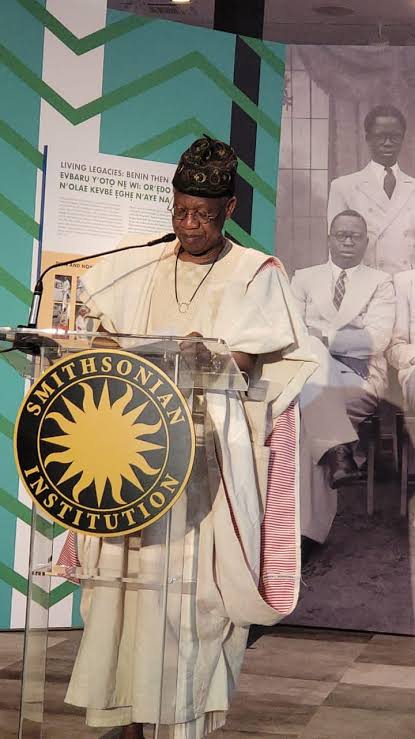
Nigeria has rejected a proposal by the British Museum to lend the Benin Bronzes to the country, insisting that artefacts taken during Britain’s 1897 invasion of the Benin Kingdom should be returned through restitution rather than a temporary loan.
The Director-General of the National Commission for Museums and Monuments (NCMM), Olugbile Holloway, described the loan proposal as insulting, arguing that Nigeria should not be expected to borrow cultural objects that were looted from its territory.
Holloway made the remarks during a discussion on cultural restitution at the 2026 Quramo Festival of Words, held in Lagos from October 1 to 3.
He said Nigerian officials remained in communication with the British Museum but maintained that any arrangement involving the Benin Bronzes must recognise Nigeria’s claim to ownership.
“We are constantly in communication with the British Museum, and in one of our meetings, I clearly told them that insinuating you want to loan us our artefacts, I find it quite insulting,” Holloway said.
He added: “I’d rather you keep them till the end of time than for you to loan something that was looted.”
His comments underline Nigeria’s position that the return of the artefacts should not be treated as a conventional lending arrangement between institutions, but as part of a broader process of addressing the historical seizure of the kingdom’s cultural heritage.
Nigeria insists restitution must involve ownership
At the centre of the dispute is the distinction between physically returning an artefact for a limited period and transferring legal ownership to its country of origin.
Holloway argued that a loan would leave Nigeria without permanent ownership of objects that originated in the former Benin Kingdom, now part of southern Nigeria.
He maintained that restitution should involve the transfer of ownership, even where the physical objects might remain temporarily outside Nigeria under an agreed arrangement.
The position reflects a broader demand by Nigeria and other countries seeking the return of cultural property removed during colonial-era military campaigns, expeditions and other forms of foreign occupation.
For Nigerian officials, the issue extends beyond access to museum collections. It concerns historical accountability, cultural identity and the right of communities to exercise authority over their heritage.
The history behind the Benin Bronzes
The Benin Bronzes comprise a celebrated collection of artworks and ceremonial objects associated with the historic Kingdom of Benin, renowned for its sophisticated artistic traditions and metalworking.
British forces invaded Benin City in 1897, during a military expedition that resulted in the removal of thousands of objects, including brass and bronze plaques, sculptures and other royal and ceremonial items.
Many of the objects subsequently entered museums and private collections outside Nigeria, making their ownership and return a longstanding subject of international debate.
Although commonly referred to as the Benin Bronzes, the collection includes objects made from different materials and encompasses a wider range of artistic forms than the name suggests.
Their significance lies not only in their artistic value but also in their connection to the political institutions, religious practices and historical memory of the Benin Kingdom.
A wider debate over colonial-era collections
The dispute reflects an international debate over how museums should address collections acquired during colonial rule, military campaigns and other historical circumstances in which consent and ownership remain contested.
Museums and governments have pursued different approaches, including permanent restitution, transfers of ownership, long-term loans and collaborative exhibitions.
However, Nigeria’s position, as articulated by Holloway, is that a loan cannot substitute for the permanent recognition of ownership.
The distinction is significant because a temporary loan ordinarily leaves legal title with the lending institution, whereas restitution seeks to return ownership to the country or community making the claim.
For Nigeria, a resolution would therefore require more than allowing the objects to be displayed temporarily at home. It would need to address who legally owns them and how that ownership is recognised.
The road ahead
The remarks indicate that discussions between Nigerian authorities and the British Museum remain an important part of the ongoing restitution debate.
A lasting resolution will depend on the terms of any agreement, the legal status of the objects and the willingness of the relevant institutions to address Nigeria’s demands.
The controversy also raises questions about how museums can preserve access to internationally significant collections while responding to claims rooted in historical dispossession.
For Nigeria, the central demand remains clear: artefacts removed from the Benin Kingdom should not be treated simply as objects that can be borrowed, but as cultural property whose ownership and historical context must be properly addressed.