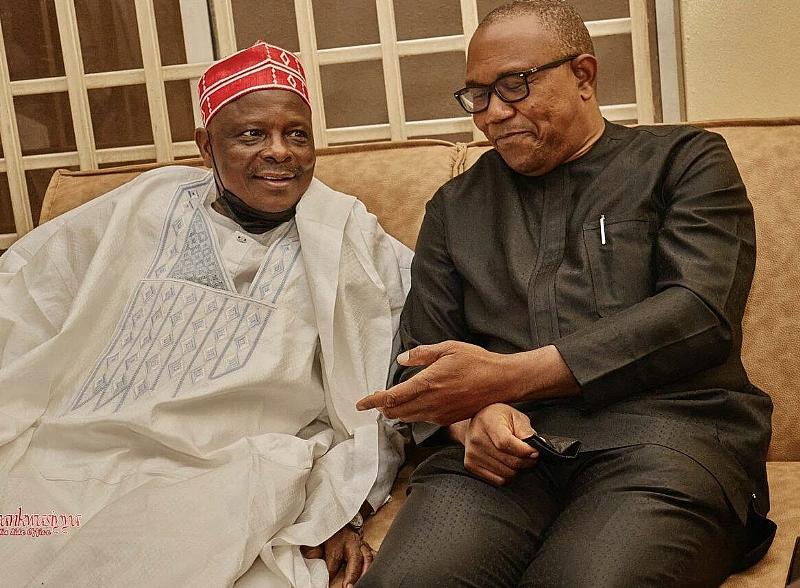
Presidential candidate Peter Obi has said his proposed campaign with Rabiu Musa Kwankwaso will not provide money to party agents for the purpose of inducing voters during the 2027 general elections.
Obi made the statement while responding to questions at a town hall meeting in Sokoto, where he appeared alongside Kwankwaso, his running mate under the Nigeria Democratic Congress (NDC).
He described the practice of distributing money to influence voters on election day as vote-buying and argued that such practices undermine electoral integrity and contribute to the country’s broader governance challenges.
Obi’s statement sets out his declared campaign position on payments intended to influence voting decisions.
Obi Criticises Vote-Buying
During the town hall meeting, Obi said his campaign would not provide money to party agents to entice voters.
He argued that vote-buying undermines the principle that citizens should choose candidates based on their judgment of policies, records and proposed solutions.
The issue has remained a concern in Nigerian elections, with electoral authorities and civil society organisations repeatedly emphasising the importance of protecting voters from inducements and other forms of electoral malpractice.
Party Agents and Election Monitoring
Party agents perform an important role in election administration by observing proceedings at polling units and monitoring the counting and recording of votes on behalf of their political parties.
Their presence can contribute to transparency when they carry out their duties in accordance with electoral rules.
However, payments or other benefits intended to influence voters or distort the electoral process raise different legal and ethical questions from legitimate expenses associated with campaign organisation and election monitoring.
Obi’s remarks focused specifically on money intended to entice voters.
Poverty and Electoral Choices
Obi linked vote-buying to broader economic hardship, arguing that financial inducements can undermine democratic accountability.
The relationship between poverty and electoral behaviour is complex, and the extent to which economic hardship influences individual voting decisions varies.
Nevertheless, the debate highlights concerns about whether immediate financial incentives can influence electoral choices at the expense of longer-term policy considerations.
Obi said his campaign intended to reject the practice of paying agents to induce voters.
Commitment Ahead of 2027
The statement provides an indication of the electoral conduct Obi says his campaign intends to uphold.
Whether that commitment translates into practice will depend on the campaign’s organisation, the conduct of its agents and the mechanisms used to monitor compliance.
As the 2027 election approaches, voters and election observers will be able to assess campaign conduct against publicly stated commitments and the applicable electoral laws.