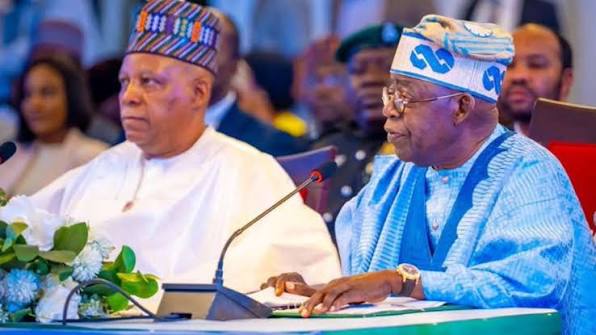
Vice-President Kashim Shettima has defended President Bola Ahmed Tinubu’s economic reform agenda, arguing that the administration’s decisions on petrol subsidy removal and foreign exchange management prevented Nigeria from sliding into economic collapse.
Shettima made the remarks after meeting Tinubu in Lagos, where he urged Nigerians to recognise the difficult decisions taken by the administration while acknowledging the economic hardship many households continue to experience.
According to the Vice-President, Nigeria’s foreign reserves stood below $3.9 billion when the administration assumed office in May 2023, a position he said left the country with insufficient reserves to finance a month’s worth of fuel imports.
He argued that the economic situation required decisive intervention, despite the immediate consequences for citizens.
“The economy was actually on the verge of collapse. He saved the economy,” Shettima said, describing Tinubu’s policy decisions as necessary to prevent a deeper national crisis.
The Vice-President specifically defended the removal of the petrol subsidy and the realignment of the foreign exchange market, two major policy changes that have reshaped Nigeria’s economic landscape since 2023.
Government defends difficult economic decisions
Tinubu’s administration has consistently argued that the previous subsidy regime placed an unsustainable burden on public finances, while the multiple exchange-rate system created distortions and undermined confidence in the foreign exchange market.
The government maintains that removing these distortions was necessary to strengthen public revenue, improve economic management and establish a more sustainable foundation for growth.
However, the immediate effects of the reforms have been severe for many households and businesses. Higher transport costs, elevated food prices and pressure on disposable incomes have remained major concerns for Nigerians.
Shettima acknowledged the difficulties, appealing to citizens not to condemn the President for implementing policies the government considers necessary for long-term economic stability.
He also said the administration was working on interventions intended to ease the burden, including transport and logistics programmes, electric tricycles, buses and electric taxis.
Among the initiatives he mentioned were plans for e-logistics in the North-West, the rollout of 10,600 electric tricycles in the North-East and the introduction of 300 buses and electric taxis.
Relief measures face the test of delivery
The government’s challenge is to ensure that these interventions translate into measurable reductions in transport expenses and improvements in household welfare.
Although macroeconomic reforms can help address structural weaknesses, their long-term success will also depend on job creation, investment, productivity and the ability of ordinary Nigerians to recover lost purchasing power.
Shettima’s remarks reflect the administration’s effort to explain its economic policies as a difficult but necessary transition. Yet the debate over their effectiveness remains open, particularly among Nigerians who continue to face financial pressure.
The coming months will therefore test whether the government can turn its argument for economic stability into tangible improvements in living standards, while maintaining public confidence in the reform programme.