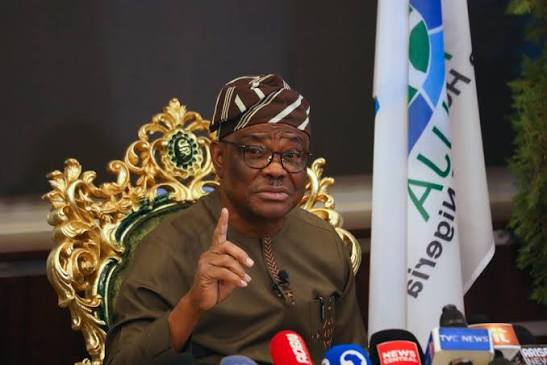
Minister of the Federal Capital Territory, Nyesom Wike, has launched a verbal attack on former Minister of Transportation Rotimi Amaechi, saying politicians he described as “bloody thieves” and “lunatics” would never become President of Nigeria.
Wike made the remarks in Abuja on Friday while speaking to journalists following a meeting involving officials of the Federal Capital Territory administration.
The comments followed Amaechi’s reported criticism of President Bola Ahmed Tinubu during political mobilisation in Edo State, where the former Rivers State governor said only “mad people” would vote for Tinubu in the 2027 presidential election.
Amaechi, a vice-presidential candidate of the African Democratic Congress (ADC), has emerged as one of the prominent critics of the President as opposition figures intensify their political activities ahead of the next general election.
Wike’s response escalated the exchange, turning a dispute over support for Tinubu into a broader personal confrontation between two former governors who have occupied influential positions in Nigerian politics.
The FCT minister accused Amaechi of hypocrisy and questioned the language used in political campaigning, arguing that such rhetoric should not be accepted as normal political discourse.
The exchange highlights the increasingly combative tone of political debate as parties and political figures position themselves for the 2027 elections.
Tinubu’s supporters have defended the administration’s economic policies and called for continuity, while opposition figures have criticised the cost of living and other challenges facing Nigerians.
Political disagreements over those issues have increasingly been accompanied by personal attacks, raising questions about whether public debate is focusing sufficiently on policy alternatives, governance records and the practical concerns of voters.
The remarks attributed to Wike are political accusations and should not be interpreted as proof of wrongdoing by Amaechi. Neither politician’s personal characterisation of the other settles the substantive questions surrounding their political records.
As the campaign period approaches, voters will be assessing the competing claims of political leaders against their records in public office, their policy proposals and their ability to address the country’s economic and security challenges.
The latest exchange underscores how political rivalries are shaping the public conversation ahead of 2027, even as Nigerians continue to demand answers on jobs, prices, infrastructure and governance.