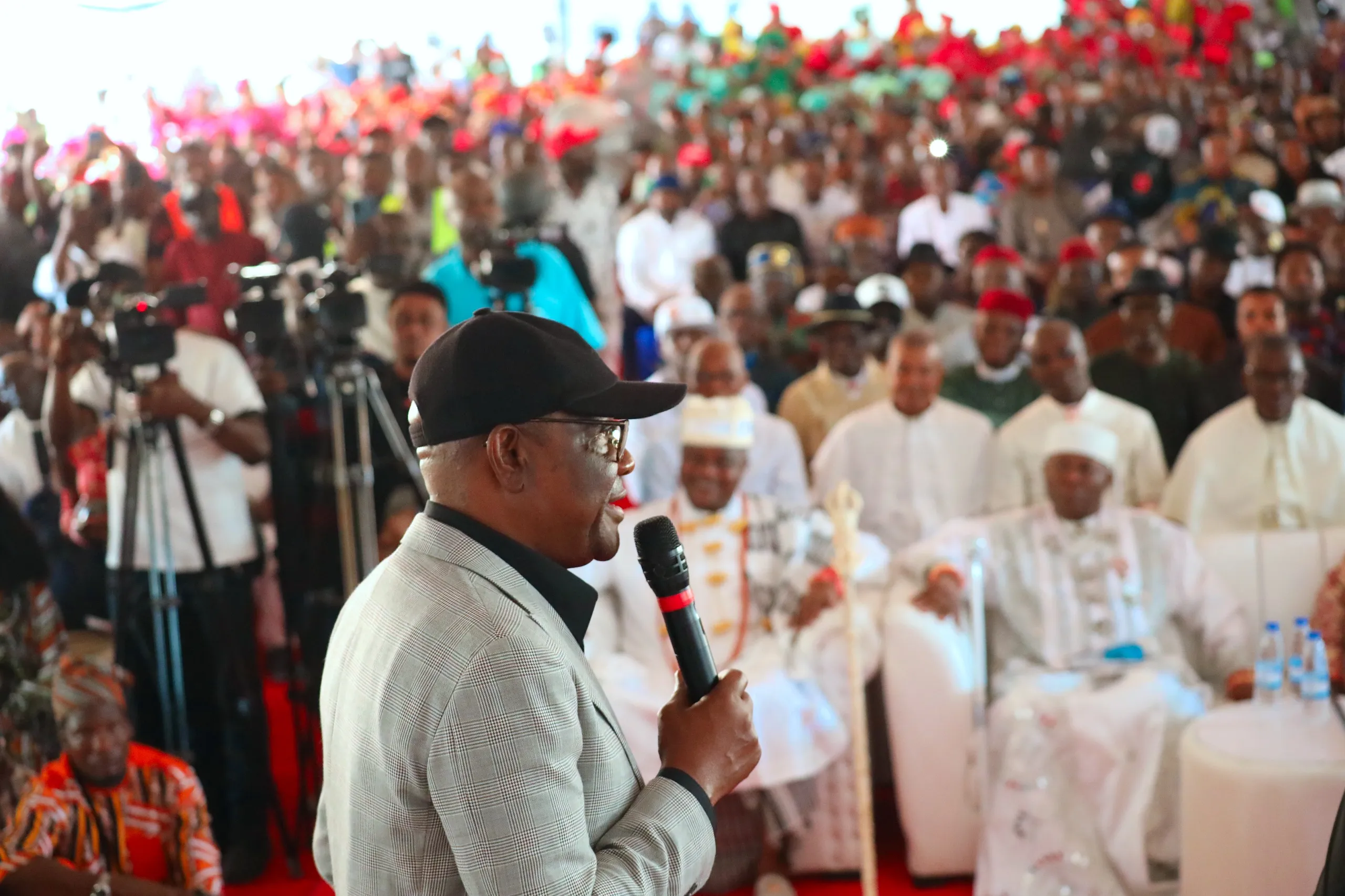

Minister of the Federal Capital Territory, Nyesom Wike, has challenged residents and political stakeholders in Evo Kingdom, Obio-Akpor Local Government Area of Rivers State, to identify tangible development projects they believe former governor Rotimi Amaechi attracted to the area during his years in public office.
Wike made the remarks during an interactive session with leaders and stakeholders of Evo Kingdom, where he questioned the development legacy of past political leaders and defended his own approach to leadership.
The minister argued that public office should be used to create opportunities for others, strengthen communities and develop human capacity rather than preserve political influence for a select group.
His comments formed part of his continuing engagement with political stakeholders in Rivers State ahead of the 2027 elections.
Wike criticises what he describes as political exclusion
During the meeting, Wike accused some political figures of seeking to prevent others from attaining positions they had previously occupied.
He said leadership should involve helping others advance rather than restricting opportunities out of personal ambition or a desire to maintain control.
“How will I answer before God if these people could take that kind of risk, and opportunity came for you to help, for you to uplift them?” Wike asked.
He added that leaders should not use their political influence to prevent other people in Obio-Akpor from becoming governors.
The comments reflect Wike’s criticism of the political conduct of some former leaders. They do not independently establish the development record of Amaechi’s administration or the extent of projects delivered in Evo Kingdom.
Development legacy becomes a political issue
Infrastructure, access to public services and opportunities for local communities are recurring themes in political debates in Rivers State.
Assessing a former administration’s development record requires examining completed projects, their locations, funding, beneficiaries and long-term effects. It also requires distinguishing projects directly undertaken by a government from those initiated by other levels of government or private organisations.
Wike’s challenge places these questions at the centre of his criticism of Amaechi and other political figures.
Political rivalry continues ahead of 2027
The exchange comes as Rivers State remains an important arena in the contest surrounding Tinubu’s re-election bid and the opposition’s efforts to build support.
Wike has publicly mobilised political stakeholders for Tinubu, while Amaechi has aligned himself with the ADC.
Their competing claims underscore the continuing struggle over political influence in Rivers State. The development records of successive administrations are likely to remain part of that debate as voters assess the arguments presented by rival political camps.