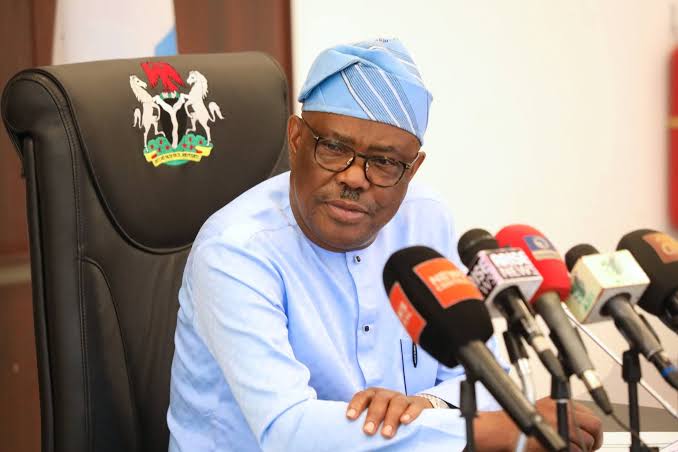
Minister of the Federal Capital Territory, Nyesom Wike, has defended the Rainbow Coalition supporting President Bola Ahmed Tinubu’s re-election bid, insisting that the initiative is intended to strengthen the President’s electoral prospects rather than weaken the All Progressives Congress (APC).
Wike made the remarks during a media parley in Abuja on Tuesday, where he explained that the coalition brings together APC members and supporters of the President from outside the ruling party.
The minister, who has been associated with coordinating the coalition’s activities in Rivers State and the FCT, said its objective was to build a broader support base for Tinubu ahead of the 2027 general election.
His comments come amid questions about the relationship between the coalition and the APC’s existing party structures, particularly as political leaders begin organising for the presidential contest.
Wike defends cross-party mobilisation
The Rainbow Coalition has emerged as a platform for bringing together political actors who support Tinubu’s re-election, regardless of their formal party affiliations.
Wike has maintained that the initiative should be assessed by its stated objective of securing votes for the President rather than viewed as an attempt to create a rival political organisation.
However, the arrangement has prompted debate within the APC. Some party leaders have expressed concern that a separate coalition could complicate party discipline and create uncertainty about political loyalties.
The disagreement reflects a broader challenge facing the ruling party as it seeks to accommodate influential political figures while maintaining a clear organisational structure for the campaign.
Implications for the 2027 contest
For Tinubu, a wider support coalition could potentially expand the campaign’s reach beyond traditional APC membership. Its effectiveness, however, will depend on how well the participating groups coordinate their activities and mobilise voters.
The arrangement also raises questions about the balance between party structures and informal political alliances in Nigeria’s increasingly competitive electoral environment.
Wike’s defence suggests that he sees the coalition as complementary to the APC rather than a substitute for it.
As the campaign develops, the relationship between the coalition, the APC leadership and other political stakeholders will be important in determining whether the arrangement strengthens the President’s electoral machinery or generates further disagreements.