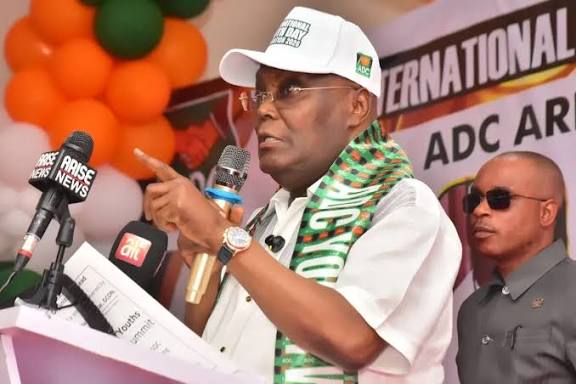
Former Vice-President Atiku Abubakar has questioned President Bola Ahmed Tinubu’s request for Senate approval to secure $20.52 billion and €1.045 billion in external loans, demanding greater transparency over the projects expected to receive the funds.
Atiku, the presidential candidate of the African Democratic Congress (ADC), said the request vindicated his October 12 warning that the Federal Government was reportedly preparing to seek a loan of up to $20 billion.
He made his position known through Phrank Shaibu, Director of Strategic Communication of the ADC Presidential Campaign Council, who conveyed the former vice-president’s concerns about the scale of the proposed borrowing and the absence of sufficiently detailed project information.
Atiku Demands Accountability Over Proposed Loans
According to Atiku, Nigerians should be provided with clear information about the projects the government intends to finance before lawmakers approve additional external borrowing.
He argued that identifying broad sectors such as infrastructure, transportation and healthcare was insufficient without a detailed breakdown showing the specific projects, their locations, estimated costs and contractors.
Atiku said the public needed access to information that would enable citizens, civil society organisations and other stakeholders to assess whether the proposed borrowing was justified and whether the funds would be used transparently.
He also recalled that he had previously called on the President to confirm or deny reports of a proposed borrowing programme linked to the Lagos–Calabar Coastal Highway.
Atiku maintained that the latest request had reinforced his earlier concerns.
Lagos–Calabar Coastal Highway in Focus
The former vice-president raised particular questions about the Lagos–Calabar Coastal Highway, a major infrastructure project that has featured prominently in political and public debates over government spending.
He questioned whether the proposed external financing would be connected to the highway and called for greater clarity about the relationship between the borrowing plan and the project’s implementation.
Atiku also referred to reports concerning changes to the highway’s route, arguing that Nigerians should be able to scrutinise the financial and contractual implications of major infrastructure decisions.
His comments reflect broader concerns about transparency in public procurement, the management of large infrastructure projects and the accountability of government institutions responsible for spending borrowed funds.
However, the specific allegations and concerns raised by Atiku do not, by themselves, establish that the proposed loans would be diverted or improperly used.
Government Faces Pressure to Explain Borrowing Plan
Tinubu’s request is intended to finance projects across several sectors, including power, transportation, agriculture, healthcare, education, water supply and security.
The proposal must undergo legislative consideration, providing lawmakers with an opportunity to examine the intended uses of the funds and their implications for public finances.
Atiku’s intervention adds a political dimension to that process, with the opposition figure calling for detailed disclosures before any approval is granted.
The debate also highlights a central question facing the administration: how can additional borrowing be justified to Nigerians while ensuring that the resulting investments deliver measurable improvements in infrastructure, economic productivity and living standards?
As the Senate examines the proposal, the availability of project-specific information and safeguards for public accountability will be important to public confidence in the borrowing programme.