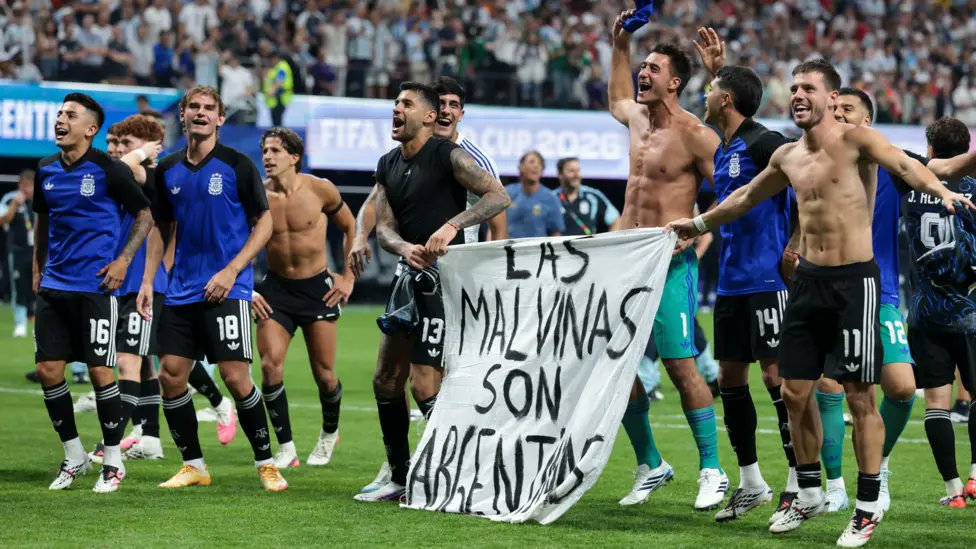
Argentina could face disciplinary action from FIFA after several players celebrated their dramatic World Cup semi-final victory over England by displaying a banner supporting the country’s claim to the Falkland Islands (Las Malvinas). The incident has sparked diplomatic criticism from the United Kingdom and could be investigated under FIFA’s strict rules prohibiting political messages during official matches.
Argentina’s memorable 2–1 comeback victory over England has quickly become overshadowed by controversy off the pitch.
Moments after securing a place in the 2026 FIFA World Cup final, several Argentine players posed with a banner reading “Las Malvinas son Argentinas” (“The Malvinas are Argentine”), reigniting one of the world’s longest-running territorial disputes and prompting calls for FIFA to investigate.
Television images showed members of the Argentina squad holding the banner during their post-match celebrations on the pitch in Atlanta.
The slogan refers to Argentina’s longstanding claim over the Falkland Islands, known in Argentina as Las Malvinas, a British Overseas Territory at the centre of a sovereignty dispute that culminated in the 1982 Falklands War.
While the message has strong domestic support in Argentina, it immediately drew criticism because FIFA regulations prohibit political, ideological or religious messages during official competitions.
The controversy quickly escalated after senior British officials condemned the display.
UK Business Secretary Peter Kyle described the incident as inappropriate and urged FIFA to examine whether Argentina’s actions breached the governing body’s disciplinary code.
British officials argued that football should remain free from political demonstrations, particularly on an occasion watched by millions around the world.
Under FIFA’s Disciplinary Code and stadium regulations, players and teams are prohibited from displaying political statements, banners or symbols during official matches and ceremonies.
If FIFA determines that the Argentine squad or officials were responsible for the banner’s display, the world football governing body could impose disciplinary measures.
Sports law experts note that previous cases involving political messages have typically resulted in financial fines, warnings or disciplinary proceedings, rather than points deductions or disqualification from tournaments. As of now, FIFA has not announced any formal sanction against Argentina.
The incident also revived memories of the intense football rivalry between Argentina and England, which has long been intertwined with the political tensions surrounding the Falklands dispute.
Matches between the two nations have often carried symbolic significance dating back to the aftermath of the 1982 war and Diego Maradona’s famous performance at the 1986 World Cup.
Wednesday’s semi-final added another chapter to that history, both on and off the pitch.
Despite the growing controversy, Argentina’s immediate attention remains on Sunday’s World Cup final against Spain.
Neither the Argentine Football Association nor FIFA had issued a detailed public statement on the incident at the time of publication, leaving uncertainty over whether disciplinary proceedings will formally commence before the championship match.
What began as a night of football celebration has evolved into an international controversy involving sport, diplomacy and history. While Argentina prepares for another World Cup final, attention will also be on FIFA’s next move as it decides whether the post-match display crossed the line between national pride and prohibited political expression.